Insurers will cover your AI film, if you can show them your homework
A HackerNoon post by the founder of an AI film tool says AI-generated films are functionally uninsurable. The broker he quotes says underwriters want evidence of human review rather than extra premium, and one insurer has already written AI cover into a media policy. Nobody we found has published a film E&O claim over AI content yet.
A production client in Canada sent its broker and an underwriter some sample images it wanted to use. Both of them checked the pictures before anyone talked about cover, and it took seconds. "Copy and paste them into the reverse image search and they came up," Nellie Lindner, who leads the film and entertainment practice at the broker BFL Canada, told Insurance Business in July. The answer from the underwriter was immediate: "Absolutely not."
That story came back this morning in a sharper form. A HackerNoon post published on Thursday 22 October, headlined "Why Nobody Will Insure Your AI-Generated Film in 2026", opens with a production company submitting AI images for a standard errors and omissions review and having the policy "rejected on the spot". It doesn't credit the anecdote to anyone, and the original doesn't mention a policy at all. From there the post makes its big claim: that "most AI-generated films are, right now, functionally uninsurable, and no insurance means no distribution."
The author is Frank Houbre, founder of Outerframe Studio in Strasbourg, which makes the AI film workspace ScreenWeaver. His cure for the problem is a shot-by-shot record of references and prompts, and he says openly that on ScreenWeaver "every shot carries its reference images and the prompt history that produced it." That disclosure is fair. It also means the headline was written by someone selling the fix, and the evidence he cites points somewhere more useful than "nobody".
Why this paperwork decides who gets distributed
Errors and omissions insurance, usually shortened to E&O, covers a film against claims that it infringes copyright, defames someone or uses a name, likeness or piece of music without permission. Distributors and sales agents ask for a certificate before they sign, typically at limits of $1 million per claim and $3 million in total, according to the International Documentary Association. One broker guide published on 16 October says the studio and streamer contracts it sees most often ask for $5 million.
So Houbre is right about where the gate sits. Festivals decide whether a film screens, while the insurer and the distributor decide whether anyone can sell it. Netflix added a second check of its own in August 2025, when it told production partners how it expects generative AI to be used. Most low-risk uses won't need legal review, the guidance says, but if the output includes final deliverables, talent likeness, personal data or third-party IP, "written approval will be required before you proceed," as The Verge reported at the time.
What the broker actually said
Lindner is the only insurance professional Houbre quotes by name, and he keeps one line from her: "They will not automatically provide AI coverage." That sentence is accurate, and she was describing the small pool of underwriters who write production E&O in Canada. When a client asks whether AI is covered, she said, the questions start: "How are you using it? What are the controls in place?" The part she treats as non-negotiable is a person standing between the tool and the finished work, checking that nothing in the output belongs to someone else.
The rest of the interview cuts against the headline. Insurance Business, summarizing her view, reported that underwriters want evidence of control rather than extra premium, and that a client who can show how the tool is used, on what platform, under which staff guidelines and with what monitoring "will generally get coverage." Lindner put the shift this way: underwriters "are doing a lot more underwriting as opposed to wanting to add on additional premiums." She also said no large AI claim has landed yet, which is exactly why they ask so many questions.
The insurer that already said yes
The HackerNoon post says the question of AI cover is "still open industry-wide". One specialist insurer closed part of it three months ago. CFC, which underwrites at Lloyd's, added affirmative AI coverage to its worldwide Media policy from 30 July 2026. Its release says the change "confirms that involving AI in media activities does not prevent coverage from responding", and that the policy can still respond to defamation and IP infringement claims where AI helped make the content.
That is a media liability policy, and we haven't read its wording, so it is not proof that CFC writes producer E&O for an AI feature. It does show that an insurer has put AI cover in writing, which is the opposite of nobody.
Houbre isn't inventing the caution, either. Front Row Insurance, a production broker, told clients in July 2025 that if a production includes AI-generated content, "you may not be able to get E&O insurance for the AI-generated content." The market is split by carrier and by broker, and the deciding factor in every account we found is the same: what you can document.
What it means if you make films with AI
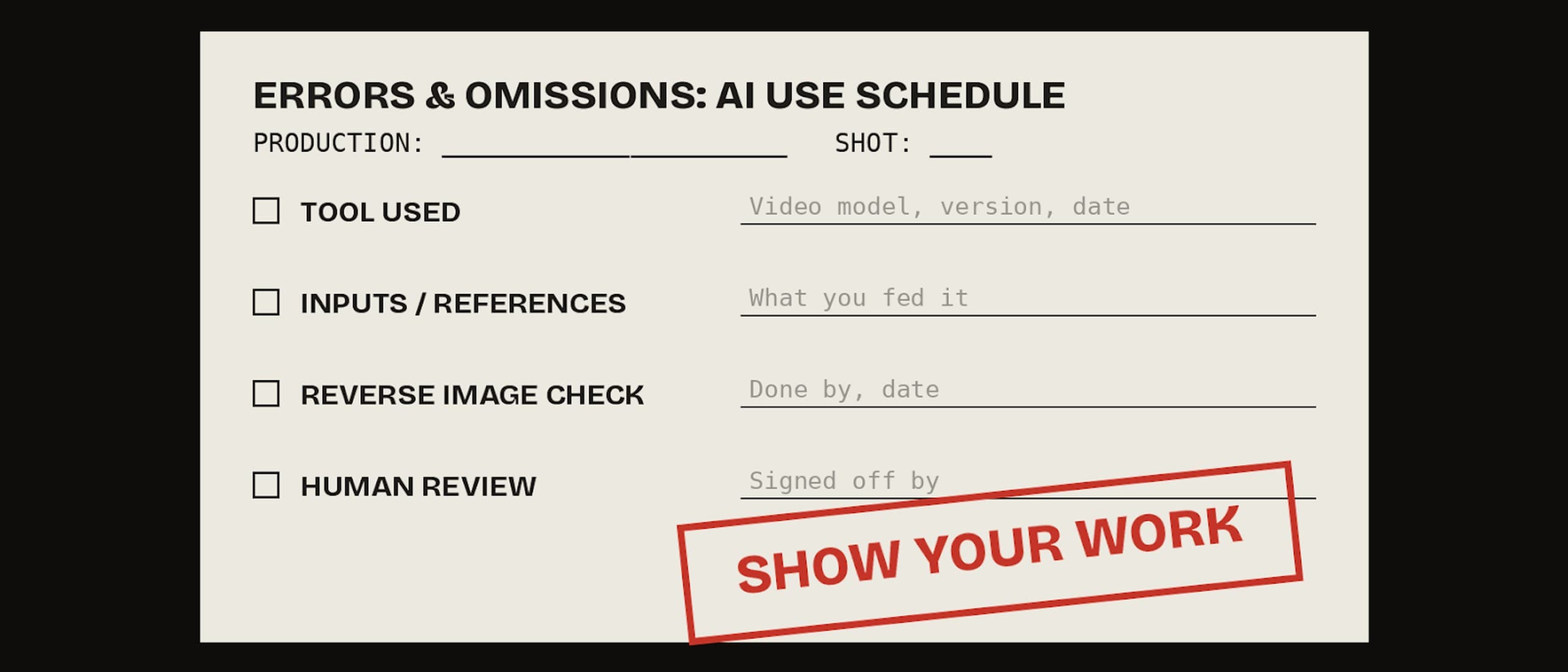
The useful reading of this story is that the homework is cheap and you can start it today. A filmmaker who keeps a dated record of tools, inputs and references, and of a human checking the results against existing work, walks into a broker's office with the answers to Lindner's two questions already written down.
- Keep a simple log from day one: which tool made each shot or element, what you fed it, and who reviewed it, and when.
- Run the same check on music, lyrics and titles, not only on images. Lindner was explicit about scope: "It covers everything."
- Ask your broker for affirmative AI wording, or written confirmation that no AI exclusion is attached, and read the policy form rather than the certificate.
- Register the parts a person authored, such as the script, edit, sound and score, and disclaim the machine-made frames, in line with the US Copyright Office report of 29 January 2025.
Our take: the gate is real, and "nobody will insure your film" is the wrong lesson to take from it. Insurers are asking AI filmmakers for the same proof of clearance they have always asked of everyone else, and the makers who keep receipts now will be the first ones a sales agent can actually close a deal with.
Timeline
- Date: 29 Jan 2025. What happened: Copyright Office publishes Part 2 of its AI report, on copyrightability of outputs; Source: copyright.gov
- Date: 14 Jul 2025. What happened: Front Row Insurance warns AI-generated content may not get E&O cover; Source: Front Row blog
- Date: Aug 2025. What happened: Netflix guidance: written approval for generated final deliverables; Source: The Verge, 22 Aug 2025
- Date: 2 Mar 2026. What happened: Supreme Court denies cert in Thaler v. Perlmutter; Source: Docket 25-449
- Date: 15 Jul 2026. What happened: BFL Canada's Lindner: no automatic AI cover, controls decide; Source: Insurance Business
- Date: 30 Jul 2026. What happened: CFC affirmative AI cover takes effect in its worldwide Media policy; Source: CFC release, 29 Jul
- Date: 16 Oct 2026. What happened: Broker guide advises asking for affirmative AI wording on film E&O; Source: Boring Insurance
- Date: Thu 22 Oct 2026. What happened: HackerNoon: "Why Nobody Will Insure Your AI-Generated Film in 2026"; Source: HackerNoon
Sources and what is unconfirmed: HackerNoon post by Frank Houbre (22 Oct), read in full; Insurance Business interview with Nellie Lindner by Branislav Urosevic (15 Jul), read in full; CFC release (29 Jul), read in full; Front Row Insurance blog (14 Jul 2025); Netflix generative AI guidance via The Verge (22 Aug 2025), since Netflix's own partner page would not load; International Documentary Association and Boring Insurance on standard limits; ScreenWeaver's own site. We did not speak to a broker or underwriter for this piece, we did not read CFC's policy wording, and we found no public E&O claim over AI film content.