Japan's AI film festival drew 730 entries, and a studio's commissioned anthology took two awards
AI Film Festival Japan handed out its awards in Tokyo on 1 November after drawing 730-plus entries by its own count, up from 413 last year. TYO's commissioned TOKYO STORIES anthology won two of the six confirmed prizes, an NTV creator won a music award, and no official results or Grand Prix winner have been published.
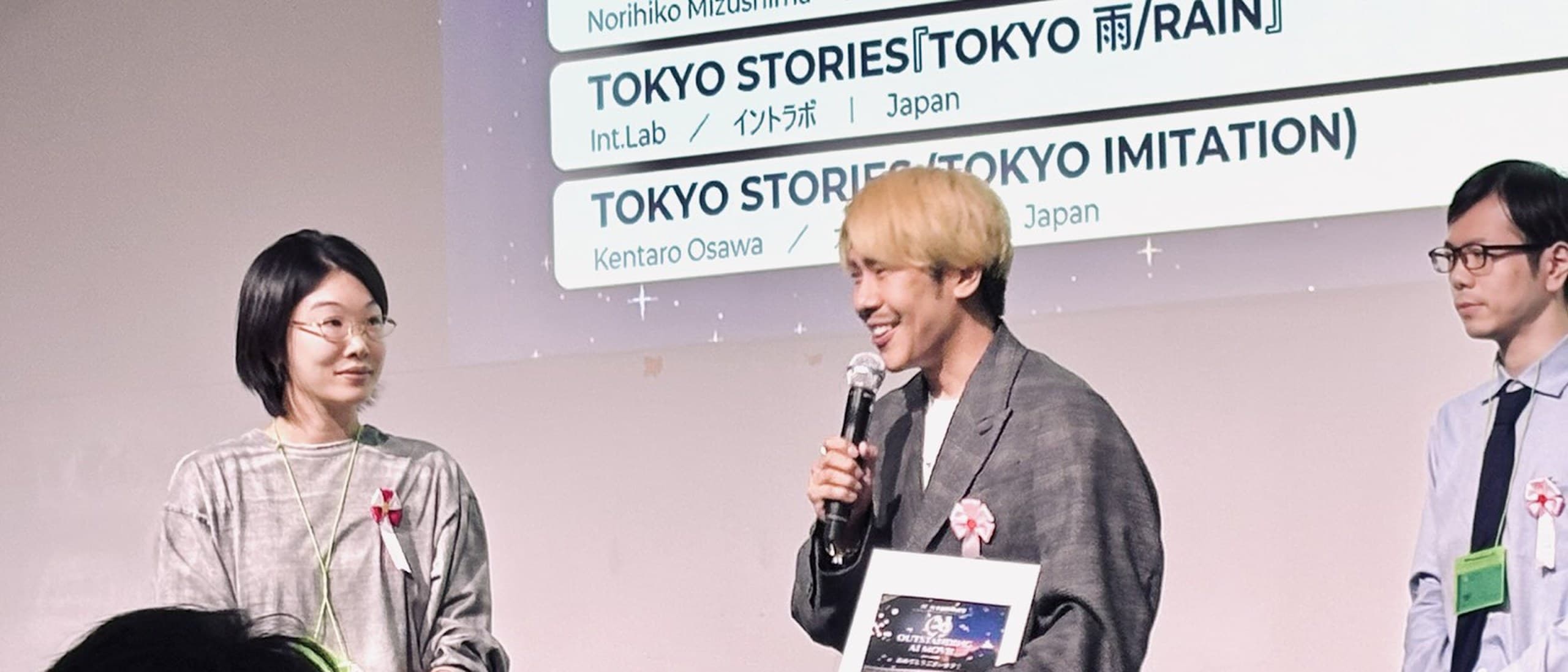
On Sunday afternoon at Tokyo Innovation Base, Norihiko Mizushima stood under a projected list of finalists with a microphone in one hand and a framed plaque for Outstanding AI Movie in the other. His short PUNCHLINE had just won the second-tier prize in the movie category at the second AI Film Festival Japan. That night he posted on X that he couldn't fully celebrate, because on the festival's first day he had watched work from creators around the world and found what he called an overwhelming gap between it and his own (our translation).
That honesty is a better guide to this festival than its headline number. The organizer says it received more than 730 entries from more than 60 countries and regions, and it handed out awards on Sunday 1 November. What it has not done yet is publish the results. As of Monday morning UK time there was no official winners list, and the Grand Prix the festival promised in October had not been named anywhere we could find. Every winner below is confirmed by the winner's own post, by CapCut Japan, or by NTV, a broadcaster with a seat on the festival's committee.
Who we can confirm won
Six awards are confirmed so far. Last year the festival posted its results ten days after the ceremony, so the list below will grow, and nothing in it should be read as the top prize.
- Award: Best AI Movie. Work: TOKYO STORIES: TOKYO RAIN (10 min); Maker: Int.Lab; Confirmed by: Maker's X post, reposted by the festival
- Award: Outstanding AI Movie. Work: PUNCHLINE (11 min); Maker: Norihiko Mizushima; Confirmed by: Maker's X post and on-stage photo
- Award: Outstanding AI Creative. Work: TOKYO STORIES: TOKYO NEW WAVE; Maker: Arata Fukoe; Confirmed by: Maker's X post
- Award: Best AI Film Music and Score (Animation). Work: Animated theme score; Maker: 821R (Honey R); Confirmed by: Maker's X post, reposted by the festival
- Award: Top prize, new film music category. Work: Score for a laundromat visual theme; Maker: Ayano Kotakari, NTV AX-ON; Confirmed by: NTV News only
- Award: CapCut AI Creative Award. Work: EISENRITTER Confronting the World; Maker: TechTalkNAVI; Confirmed by: CapCut Japan and the maker
- Award: Grand Prix, Best AI Animation, Best AI Creative, ElevenLabs Best Use of Voice. Work: Not yet known; Maker: Not yet known; Confirmed by: No official list as of Monday
The numbers are the festival's own
The count of 730-plus entries, 68 official selections and 21 finalists comes from AI Film Japan Inc., the company behind the event. Its website, its press release and the TV reports all repeat the same figures, and nobody has audited them. The growth is still real on the festival's own terms. Dentsu Creative Pictures, which won Best AI Comedy at the first edition in November 2025, reported that year's field as 413 entries from 40 countries, so submissions are up by roughly three quarters in a year.
NTV, relaying the organizer, said most entries were shorts of five to ten minutes plus animation, and that Japan, China and Korea supplied more than half of them. The festival also told NTV that Seedance was the most used video model across entries and Suno the most used music tool. That ranking presumably comes from the tool disclosures every entrant has to file, but no numbers or method were published, so treat it as a signal rather than a census.
A commissioned anthology on the winners' stage
The most interesting pattern in the confirmed list is who paid for the films. TOKYO STORIES is an anthology of 14 AI shorts about Tokyo that the commercial production company TYO commissioned and launched on Monday 2 March 2026, with planning and production by its TYO drive unit. Two of the six confirmed awards went to that one anthology, Best AI Movie for Int.Lab's TOKYO RAIN and Outstanding AI Creative for Arata Fukoe's TOKYO NEW WAVE, and a third TOKYO STORIES short was a finalist. The anthology had already won at WAIFF Kyoto in March. We found no sign that TYO sponsors this festival.
Broadcasters were close to the stage too. The top prize in the new film music category went to Ayano Kotakari of NTV AX-ON, according to NTV's own report, and that report is the only confirmation. The festival's staff page lists an NTV Digital executive as its auditor, and an NTV AX-ON producer spoke at the event. Nothing here suggests the judging was bent, but NTV can't serve as an independent check on a festival it helps run, and the English write-up at News On Japan is a rewrite of the NTV piece.
What the winners and one attendee said
The winners' own posts were more candid than the coverage. Arata Fukoe wrote that the experience taught him an AI film is not something you make alone, and that script, direction, editing, visual design and sound all need professionals working together (our translation). He added that piling on crew the way a traditional production does doesn't work either, so finding a right-sized team is the job.
Jonah Bennett, an attendee who posted notes after the first day, said a couple of films were good enough that the average viewer would not have known they were AI, while "a lot of the selections shouldn't have made the cut at all." He wrote that directors with film industry training produced far more professional work and that "the highest quality video generation came from seedance, and it wasn't close." His role at the festival is unconfirmed, and his is one viewer's opinion, but it matches what Fukoe and Mizushima said about craft.
Committee chair Kazunori Kurimoto gave the official version of the same point to NTV, saying that however far AI evolves, what finally decides the quality of a work is the creator's own worldview and creativity (our translation).
The fine print for entrants
This is a low-stakes festival with a business conference attached. Entry cost $29 to $49 per film category depending on the deadline, and $19 for music, according to an archive of the FilmFreeway listing we could not open directly. We found no cash prize on any official page. The confirmed rewards are trophies, a year of CapCut Pro with 50,000 AI credits for the CapCut winner, and a song release for the vocal track winner.
The rules ask more than the prizes give. Entrants must disclose which AI tools they used and where, and the committee may ask for prompt histories or production logs. Every entrant also grants the festival a non-exclusive, worldwide, royalty-free and perpetual license to screen and promote the work, and waives moral rights over excerpts. The two sponsored awards work differently, too. The CapCut award was picked from CapCut's own contest shortlist and weighted partly on use of CapCut, while ElevenLabs says using its tools was not required and earned no bonus.
Where the festival does pay off is the room. Three of Japan's commercial broadcasters, TBS, NTV and TV Asahi, shared a panel on AI in TV production, and the program listed the head of K2 Pictures, the company behind the live-action Look Back, among its speakers. We could not confirm that he appeared.
What it means for AI creators
An open-call festival that rewards studio commissions tells you where the work is coming from in Japan right now. Four things are worth acting on.
- The selection list is a lead list, since 68 named makers and 21 finalists are now public on the festival site, and studios like TYO clearly go looking for people who can deliver a finished short.
- Your tool log is part of the entry, because the festival can ask for prompt histories, so keeping versions, prompts and who did what from day one costs nothing and saves a scramble.
- The license deserves a read before you pay the fee, since a perpetual promotional license is standard at many festivals but should be a choice you make on purpose.
- Craft still decides the result, as the winners themselves say, so a small team that covers script, edit and sound beats a better model in the hands of one person.
Our take
Corporate money winning at a festival sold as a showcase for new voices will sting for solo makers paying $49 an entry, and that frustration is fair. The better reading is that commissioning has become the real door. TYO paid creators like Int.Lab and Arata Fukoe to make shorts, and those shorts are now award winners with their names on them. Independent creators should treat this festival less as a lottery and more as a place to get hired, and the festival should publish its full results, Grand Prix included, before anyone calls this year's field the best it has had.
Timeline
- Date: Sun 2 Nov 2025. Event: First AI Film Festival Japan opens in Tokyo, with 413 entries from 40 countries; Source: Dentsu Creative Pictures
- Date: Tue 11 Nov 2025. Event: First edition's results published, category awards only; Source: aifilm.jp, AICU
- Date: Mon 2 Mar 2026. Event: TYO launches TOKYO STORIES, 14 commissioned AI shorts about Tokyo; Source: TYO
- Date: Fri 31 Jul to Wed 30 Sep 2026. Event: Early, regular and late entry deadlines; Source: FilmFreeway listing via fee archive
- Date: Fri 16 Oct 2026. Event: 68 selections and 21 finalists announced, Grand Prix promised; Source: PR TIMES release via jiji.com
- Date: Sat 31 Oct 2026. Event: Festival opens at Tokyo Innovation Base; Source: aifilm.jp, festival X account
- Date: Sun 1 Nov 2026. Event: Awards ceremony, 15:00 to 16:30 Tokyo time; Source: Festival program, NTV News
- Date: Mon 2 Nov 2026. Event: Final day: conference, winners' screening, closing party; Source: Festival program
Sources and what is unconfirmed: aifilm.jp (home, nominations, program, guidelines, CapCut, ElevenLabs and music pages, staff page, 2025 results); PR TIMES release via jiji.com (16 Oct 2026); NTV News (1 Nov 2026); Dentsu Creative Pictures (6 Nov 2025); TYO news (2 and 13 Mar 2026); Luma event page; X posts by Int.Lab, Norihiko Mizushima, Arata Fukoe, 821R, TechTalkNAVI, CapCut Japan, the festival account and Jonah Bennett. Japanese quotes are our translation. Not confirmed: the Grand Prix and four other category winners, Kotakari's award beyond NTV, K2 Pictures' appearance, entry fees on FilmFreeway itself. We did not watch the winning films.