An AI actress got a six-figure rate card in China. Live-action actors got the winter
Fang Taozi, an AI character built by a solo creator, was listed at up to 258,000 yuan an ad before her first campaign was pulled over invented testimony. China's short-drama actors have lost far more since February, through cheap AI video, platforms pulling funding and investors leaving, while live action still wins the plays.
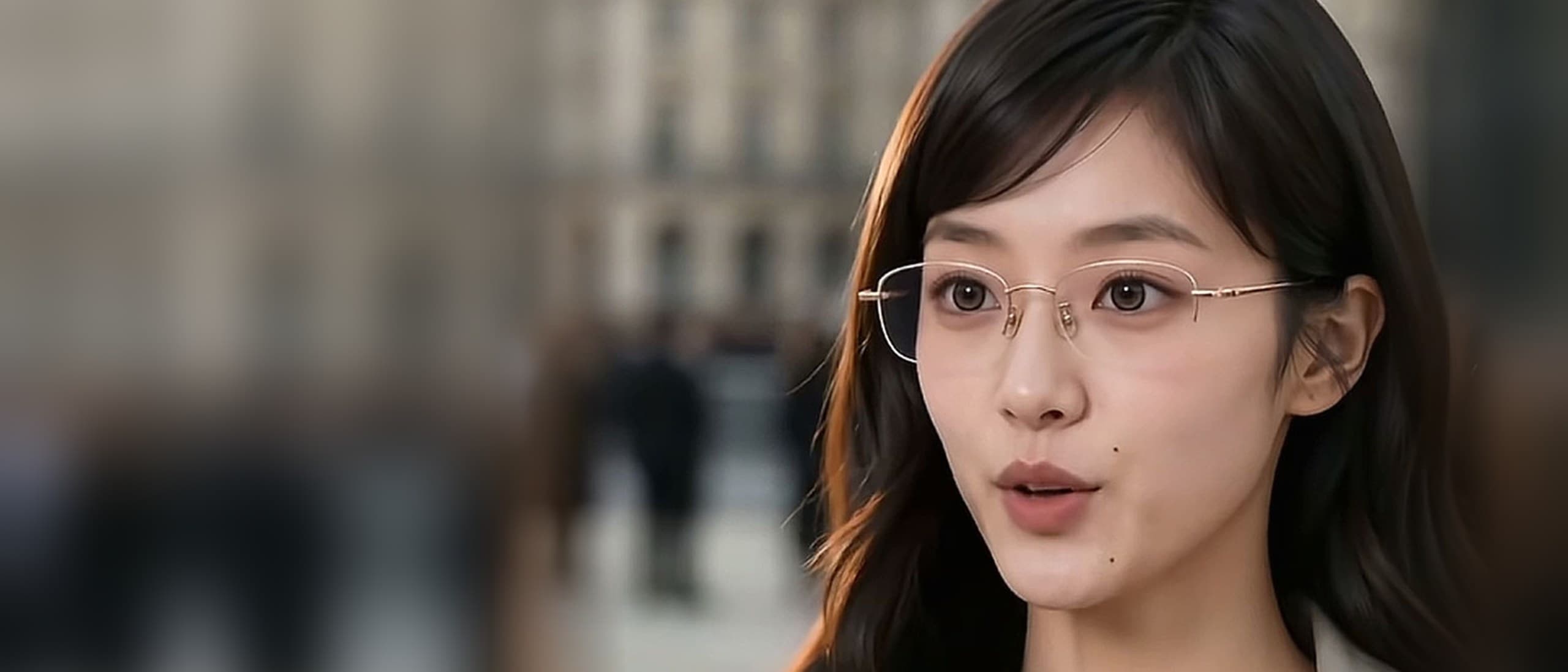
A young woman in clear-framed glasses listens to a friend complain that her contacts hurt. She pulls a box of lenses from a black handbag and offers it over. "My contact lenses are comfortable even after wearing them all day," she says, in Sixth Tone's translation. "Do you want to try them?" Neither woman is real, and the one holding the box is Fang Taozi, an AI character with blunt bangs and two moles, and the ad she was selling went up on Douyin for the contact lens brand Nutnutlook at the end of July. Within about a week it was gone.
On Wednesday China Daily used Fang Taozi as its lead example of AI actors moving from short dramas into advertising, next to a drama student who says work in Hengdian, the country's biggest studio town, is drying up. Both halves are real, but the paper has them the wrong size. The ad story is one character and one pulled campaign from August. The squeeze on human actors is much bigger and better documented than one friend's account, and AI is only part of what caused it.
A solo creator's character with a rate card
Fang Taozi was not built by a studio. She first appeared in The Laid-off Girl, an AI series that debuted on Douyin on 12 June, about a small-town girl chasing a modeling career in a fictional city. It was directed by Fei Feifei, a short-video creator who has been posting since 2018. Sixth Tone counted more than 320 million views by 12 August, and the character's own account passed 470,000 followers in the same window. Fans liked that she has moles and blemishes, which most AI faces do not. On 27 August the fashion magazine Cosmo Crush previewed her on Weibo.
Then came the rate card. Chinese media reported that Douyin's influencer marketplace, Juliang Xingtu, listed her at 168,000 yuan (about $24,900) for a clip under 20 seconds, 208,000 yuan for up to a minute and 258,000 yuan for anything longer. That is well above what most human influencers charge, though China Daily itself points out that listed rates are not what anyone actually paid. Hou Wenjie of the Yu Ce Think Tank told the paper the lesson is operational, not technical: Fang has her own account posting cooking, fitness and commuting clips, which gives followers the everyday company they get from a human creator.
The tools are less clear than the reach. LibTV's own operations lead has said season one was made on its platform, and a partner post on The Paper says season two was made entirely on ByteDance's Xiaoyunque with Seedance 2.5. Both accounts come from the platforms. Sixth Tone names the company behind the character as Guangzhou-based World Media Film and TV Culture, and neither it nor the brand commented.
Where the ad crossed the line
The ad did not fail because the face was synthetic. It failed because of what the face claimed. Colored contacts are Class III medical devices in China, the highest-risk tier, and the Advertising Law bars any endorser from recommending them. An AI character is not a person in law, so it is not technically an endorser, but the lawyer Ma Lihong of Beijing DHH told Chinese media that a first-person line about wearing the lenses all day could still count as invented user experience and false advertising, with the brand and the producer liable. A complaint was referred to the market regulator in Chuzhou's Langya District, and we found no ruling as of Thursday.
Viewers made the same point more bluntly. "What makes me uncomfortable is that someone without eyes now has the right to speak about eyes," one wrote, in Sixth Tone's translation. A Guangzhou regulator told Jiemian in August that AI as a form is legal if it is labeled, and that misleading content is judged case by case.
The winter on set
The labor story is where China Daily undersells itself. Sixth Tone's August reporting from Zhengzhou, the country's biggest vertical-drama hub, found one producer, Zhoutu Culture, cut from as many as 200 dramas a month to about 30 and from more than 500 staff to about 200. The trigger was February, when ByteDance released Seedance 2.0 at around 1 yuan per second of footage and its drama app Hongguo began withdrawing guaranteed funding from small and midsize live-action projects. "The landing was extremely hard," Zhoutu's founder, Wang Huan, told Sixth Tone.
The actor Luo Haoyu told the same reporter his monthly income fell from around 20,000 yuan to roughly 5,000 yuan, with 20 working days in the three months after Spring Festival. He described it plainly: "I felt confused and lost. What am I supposed to do in the future?" A background actor, Shi, was paid 110 yuan for a morning spent waiting to fall over as a guard, and was still owed 800 yuan by a company that had vanished: "Construction workers can at least find someone to demand their wages from. With film crews, they're long gone."
The national numbers point the same way. The China Netcasting Services Association counted 128,000 micro-dramas released in the first quarter, more than 95% of them AI-generated. On 17 September the broadcast regulator told a State Council press briefing that 430,000 had gone live in the first eight months, 13 times all of 2025, with AI titles above 90%. In Hengdian, a trade tally of weekly crew listings by the industry account Yule Ziben Lun shows 22.75 crews shooting per week in the first half of 2026 against 30.27 a year earlier, down 24.84%.
What AI did, and what it did not
That Hengdian figure is mostly long-form costume television, which is in a budget winter of its own, so it cannot be pinned on AI actors. A Taiwanese trade columnist, Du Shengcong, called AI an accelerant rather than the only culprit, alongside platform strategy and investors pulling out. China Daily's other number needs correcting too. It quotes AI short dramas at around 80,000 yuan per minute, but other Chinese reporting this year puts them at roughly 1,000 to 6,000 yuan per minute, with 80,000 to 150,000 yuan buying a whole drama.
The counter-number is the most useful line in the whole story. Over Spring Festival, the association found, live-action dramas were one fiftieth of AI titles by count and drew 25 times the plays. Money is moving back to live action as well. ByteDance pledged 1.5 billion yuan for live-action short dramas by May, six platforms announced at least 6 billion yuan, and the regulator now tells platforms to open live-action sections and back them with "real money", in our translation. Since 1 September every episode of an AI micro-drama has to carry an AI label.
The opening on both sides
For AI filmmakers, Fang Taozi is a template with a warning attached.
- A recurring character with a consistent face, a life between episodes and its own account can price like a mid-tier influencer. The value sits in running the character, not in the model that renders it.
- Category decides whether a brand deal survives. In China, an AI face saying it used a product counts as invented testimony, and medical devices, beauty and food are where that bites first.
- Live-action makers have a scarcity edge the data backs: fewer titles, far more plays and new money ring-fenced for them.
Our take: The AI actress made headlines, but the real story is a creator who built a character worth a rate card, and the live-action actors who are now the scarce thing worth paying for.
Timeline
- Date: Feb 2026. What happened: ByteDance releases Seedance 2.0; Hongguo starts pulling guaranteed funding from small live-action projects; Source: Sixth Tone
- Date: Thu 30 Apr 2026. What happened: Industry association counts 128,000 Q1 micro-dramas, over 95% AI; Source: CNSA via People's Daily
- Date: Fri 12 Jun 2026. What happened: The Laid-off Girl debuts on Douyin, introducing Fang Taozi; Source: China Daily; Jiemian
- Date: Fri 31 Jul 2026. What happened: Nutnutlook contact lens ad featuring Fang Taozi goes up on Douyin; Source: Sixth Tone; Jiemian
- Date: Mon 3 Aug 2026. What happened: Her listed Xingtu rates trend on Weibo; Source: Jiemian
- Date: About Thu 6 Aug 2026. What happened: Ad taken down; complaint later referred to the Langya District regulator; Source: Sixth Tone; Phoenix Anhui
- Date: Mon 24 Aug 2026. What happened: Sixth Tone reports the short-drama winter from Zhengzhou; Source: Sixth Tone
- Date: Thu 27 Aug 2026. What happened: Cosmo Crush previews her on Weibo; Source: China Daily; 36Kr
- Date: Tue 1 Sep 2026. What happened: AI label required on every episode of AI micro-dramas; Source: NRTA Order No. 16
- Date: Thu 17 Sep 2026. What happened: Regulator: 430,000 micro-dramas in eight months, over 90% AI; real money for live-action; Source: State Council briefing via Beijing News
- Date: Wed 21 Oct 2026. What happened: China Daily feature on AI actors and Hengdian; Source: China Daily
Sources and what is unconfirmed: China Daily (21 Oct), read in full; Sixth Tone, 12 and 24 August, read in full; Beijing News on the 17 September briefing; Jiemian, NBD and Phoenix Anhui on the ad, its rates and the regulator referral; the CNSA first-quarter guide via People's Daily; the Yule Ziben Lun crew tally as reported by Sohu and NetEase; Du Shengcong's column in J-Media (17 Sep). Chinese quotes are Sixth Tone's translations unless marked as ours. We could not independently trace China Daily's student actor or his short, did not open Fang Taozi's Douyin account, the Xingtu listing or the removed ad, and found no ruling from the Langya regulator. The season two tool claim comes from a platform partner post. Who owns the character, and how that company relates to Fei Feifei, is unconfirmed.
Your Voice
I watched a video about how these are called micro-dramas. They're really big in China. They used actors in China, but now they're doing AI for everything.
One AI series: 81 episodes, 12 people, 30 days, ~$15K of compute. One Stranger Things 5 episode: a reported ~$50M. Here's what that gap really buys, and what it doesn't.
Quoted from public posts on X and credited by handle. If one of these is yours and you want it removed, message @the__generated on X and it comes down.
Got something to say? Tag @the__generated on X