China's AI short dramas are cheap to make. A broker's own math says few of them pay
China Literature closed up 15.5% on 2 Nov as investors bought the AI short-drama factory story. Guosen's report behind it says audiences tolerate low quality, but its own math puts break-even near 6M plays a title, rewarding one-person studios that hit. The 150M overseas figure comes from one broadcast with no source.
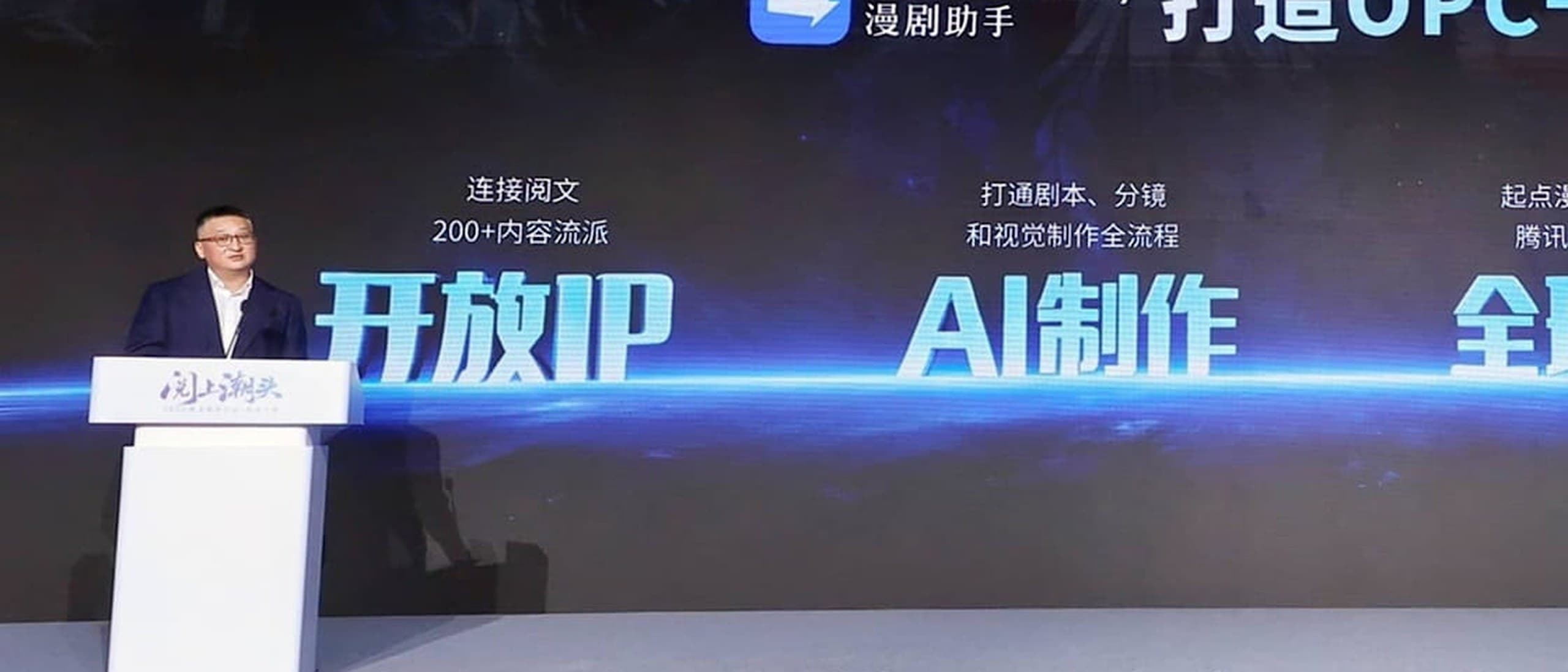
On Friday 16 October, at China Literature's annual creation conference in Hangzhou, chief executive Hou Xiaonan stood at a white lectern under a wall of screens that read "DramaBuddy" and "OPC one-stop platform." Four words in giant blue type ran beside him: open IP, AI production, global distribution, creator incentives. His pitch, in our translation of the Chinese coverage, was that one creator with a licensed story and AI tools can now finish an entire animated drama alone, and that future content will increasingly come from these one-person companies.
Seventeen days later, on Monday 2 November, the market paid for that idea. China Literature's shares closed up 15.5% in Hong Kong at HK$24.68, on two to three times their usual volume, as investors piled into anything tied to AI-made short drama. The trigger was a week of upbeat numbers: 467 million monthly users on short-drama apps, a state broadcaster's claim that Chinese AI animated dramas are winning abroad, and a broker report calling short drama a perfect fit for AI factory production. Read the same broker report to the end, though, and it says something the rally skipped. The factory only pays for the few creators who can hit.
A week of numbers, sold as one day
The English-language write-ups that spread on 2 November bundled four sources from four different days into one story. The 467 million figure comes from QuestMobile's autumn traffic report, published on 27 October. It counts monthly active users of dedicated short-drama apps in August 2026, up 77.6% on a year earlier, and it excludes the mini-programs inside WeChat and Douyin. Add those and the broker Guosen Securities puts deduplicated short-drama users at about 851 million.
The "highly suited" line that headlines attributed to brokers in general comes from one Guosen report, by analysts Zhang Lunke and Wu Linxuan, dated Sunday 25 October. The overseas figures came from a CCTV Finance broadcast on 30 and 31 October. Only the stock move happened on 2 November. We read the broker's published summary rather than the full report, and the QuestMobile numbers through two Chinese reprints, so treat the exact decimals with that in mind.
The rally itself deserves context. The Hang Seng Tech index rose 2.25% the same day, and game publisher XD gained 14%, so part of the jump was a broad tech and media bid. China Literature is still down about 25% for the year. Its first-half profit fell 84% to RMB 135 million, although most of that drop came from a one-off tax payment and a high base the year before; on the company's adjusted measure profit fell 49%. A second Hong Kong name in some reports, China Star Entertainment, rose 11% on thin turnover, and its own news that week was a loss narrowing and a planned share sale by its controlling shareholder, which makes it a weak signal for anything.
The bet on quality tolerance
Here is the sentence from the Guosen summary that matters most, in our translation. Compared with web novels and long video, short drama is a low-cost, mildly addictive consumer product whose audience has a high tolerance for product quality but strong demands for timeliness and sensory stimulation, which makes it highly suited to AI's industrial production capability. The rally coverage kept the conclusion and dropped the reason.
That reason is the honest description of what this market rewards. It isn't asking for the best AI filmmaking in the world. It wants speed, volume and a hook every ninety seconds, delivered cheaply enough that a miss costs little. Guosen says AI dramas and animated dramas reached about 90% of new titles on the leading short-drama apps at home and abroad in September and October, and that photoreal AI dramas on Douyin climbed to about 25,000 new titles a month after ByteDance's Seedance 2.0 video model arrived. China's broadcast regulator gave a similar figure in September, saying more than 90% of new micro-dramas now use AI.
Cheap episodes, rare hits
The same report then does the arithmetic the headlines left out. At a typical payout of RMB 15 per 10,000 plays, an AI short drama costing RMB 9,100 (about $1,360) needs roughly 6.07 million plays just to break even on gross margin. In 2025 only 4.4% of Douyin's native short dramas passed 10 million plays, and only 0.2% passed 100 million. One 100-million-play hit covers the cost of about 15 titles, which is why Guosen concludes that producers live or die on a stable hit rate, and that mid-tier producers keep getting squeezed out.
- Claim: Plays to break even on one AI title. Figure: About 6.07M at RMB 15 per 10,000 plays; Who says so: Guosen, 25 Oct
- Claim: Douyin native dramas past 10M plays (2025). Figure: 4.4% (0.2% past 100M); Who says so: Guosen, 25 Oct
- Claim: Cost per finished minute of AI animated drama. Figure: As low as RMB 350 (about $52); Who says so: CCTV Finance, 30-31 Oct
- Claim: Production cycle per title. Figure: From 90 days to about 10; Who says so: CCTV Finance, 30-31 Oct
- Claim: Payout per 10,000 plays. Figure: RMB 1 to a few dozen at home; $1 to $10 abroad; Who says so: One Shanghai studio founder on CCTV
Read together, those figures describe a lottery with cheap tickets. Making an episode has never been cheaper, and getting it watched has never been more crowded. None of the cost figures comes with a method, and the per-view rates are one founder's description of his own business, so they are a sketch of the economics rather than a rate card.
Who gets paid: the one-person studio
China Literature's answer to the hit problem is to sit in the middle. DramaBuddy, its AI production assistant for animated drama, is being turned into a single front door for solo creators: licensed stories from its Qidian library, production tools, distribution through its own apps, Tencent's ecosystem and third-party channels, and an A to S creator rating that decides who gets what support. The company says the tool already serves more than 400 studios and 50,000 creators, that it has signed more than 5,000 individuals and studios, and that its ten highest-earning one-person companies each make more than RMB 1 million (about $150,000) a year. It also says it will subsidize up to about 30% of creators' computing costs.
Chen Weiyu, who heads the company's AI platform department, told the tech outlet 36Kr that DramaBuddy does not exist to "make money selling tokens." The catch is access. A story from the library goes only to a team that passes an assessment of its production ability, because, as Chen put it, "If a partner with weak production capabilities gets a great IP and makes something poor, it can actually damage the value of the original IP." The stated goal is to "get the right IP into the right hands."
The labor math is in the same interview. Huang Haonan, founder of Jiangyou Wenhua, an animated-drama studio China Literature has invested in, said ten people once needed a month to make one series and one person can now make three in that time. His workforce has fallen from a peak of 1,500 to a few hundred. He predicts China will have no AI animated-drama production companies after 2026: "In the future, it will all be OPCs," he said.
The company's own results show why it is leaning in. Short drama and AI animated drama brought in more than RMB 430 million (about $64 million) in the first half, a 2.3-fold increase on a year earlier, and about 27% of its IP operations revenue, while online reading revenue fell 7.3%. Its claims that its hit rate runs at four times the market average come with no stated baseline, so they are the company's word.
The overseas number nobody sourced
The most quoted figure of the week is also the weakest. CCTV Finance reported that overseas AI animated dramas have passed 150 million active users and that Chinese companies hold nine of the top ten overseas paid short-drama apps. The broadcast named no data source, no period and no definition of active. Every English version we found traces back to that one report. The app ranking is consistent with other industry data showing Chinese-backed apps dominating overseas downloads, but it is still the broadcaster's claim.
The same broadcast credited an unnamed institution with forecasting that AI animated drama alone would pass $4 billion overseas in 2026. A Securities Daily report on 30 October attributed a $4 billion figure to the data firm DataEye, but for AI live-action dramas and animated dramas combined. It looks as if the broadcast narrowed a combined figure to one format, so we aren't printing $4 billion as the size of the animated-drama market.
What it means for AI creators
For makers outside China, the useful part of this story isn't the stock chart. It's a working model of an AI-native content economy, run at enormous scale, with its incentives in plain view.
- Volume is cheap and attention is the scarce resource. The break-even math rewards a slate with a hit rate, not a single polished title.
- Platforms are becoming the studio. Licensed stories, compute subsidies and distribution are bundled, and in exchange the platform rates you and controls the library.
- Overseas pays more per view, according to one founder who moved most of his business abroad in six months, and Chinese apps already dominate that market, which is the market Western vertical makers sell into.
- Craft still counts at the top. China Literature says weak production can damage a story's value and gates its best material behind an ability check.
Our take: the rally priced in the factory, but Guosen's own numbers say the money flows to whoever can hit reliably. That is a creator skill, story sense and speed, not a model feature, and it is the part of the job that cheap tools haven't made cheap.
Timeline
- Date (2026): Tue 11 Aug. Event: China Literature first-half results: short drama and AI animated drama above RMB 430M, up 2.3-fold; profit down 84%; Source: HKEX filing
- Date (2026): Thu 17 Sep. Event: Broadcast regulator says more than 90% of new micro-dramas use AI; Source: NRTA at a State Council Information Office briefing
- Date (2026): Fri 16 Oct. Event: China Literature creation conference in Hangzhou; Hou Xiaonan announces the DramaBuddy one-person-company platform; Source: Sina Tech; The Paper
- Date (2026): Sun 25 Oct. Event: Guosen report: short drama "highly suited" to AI production, break-even at about 6.07M plays; Source: Guosen summary
- Date (2026): Tue 27 Oct. Event: QuestMobile autumn report: short-drama apps at 467M monthly users in August; Source: QuestMobile via Tencent News
- Date (2026): Wed 28 Oct. Event: 36Kr interviews with Chen Weiyu and Huang Haonan published in English; Source: KrASIA
- Date (2026): Fri 30 Oct to Sat 31 Oct. Event: CCTV Finance: 150M overseas AI animated-drama users, nine of top ten overseas paid apps Chinese; Source: CCTV via 21jingji
- Date (2026): Mon 2 Nov. Event: China Literature closes up 15.5% at HK$24.68; Hang Seng Tech up 2.25%; Source: Longbridge; StockAnalysis
- Date (2026): Tue 3 Nov. Event: China Literature gives back about 4% in morning trade; Source: StockAnalysis (intraday, not a close)
Sources and what is unconfirmed: QuestMobile autumn 2026 report via Tencent News and Jiemian; Guosen Securities AI industry report no. 24 (published summary; full PDF not read); CCTV Finance via 21jingji and CCTV's Weibo; China Literature interim results (HKEX, 11 Aug 2026); KrASIA, Cheng Zi, 28 Oct 2026, adapted from 36Kr; Sina Tech and The Paper on the 16 Oct conference; Securities Daily via Sina Finance, 30 Oct 2026; Longbridge, TipRanks and StockAnalysis market data. Unconfirmed: the 150M overseas user figure and its definition; the $4B forecast's scope; China Literature's hit-rate multiples. Hou Xiaonan's conference remarks are our translation of Chinese coverage. Dollar conversions use RMB 6.68 to the dollar. We found little reaction to the story on X.
Your Voice
China’s advancement in AI comic-style animated shorts is transformative, standing apart from the AI short films generated by U.S. large models.
Simply put: AI made animation cheaper, but it didn't make getting seen cheaper.
The microdrama industry in China went fully AI and threw lots of people out of work. Now it's doing so badly that companies can't even recoup token costs.
Quoted from public posts on X and credited by handle. If one of these is yours and you want it removed, message @the__generated on X and it comes down.
Got something to say? Tag @the__generated on X