An AI music video every 2.6 days. What do Chris and Crystal actually own?
Crystal Trimble and Chris Marsh post a polished AI music video every 2.6 days and sell the songs on YouTube and Spotify. Their legal line calls the work fully owned, but Suno's September terms warrant no copyright, cap Pro downloads at 20 a month, and the Copyright Office protects only the human lyrics and edit.
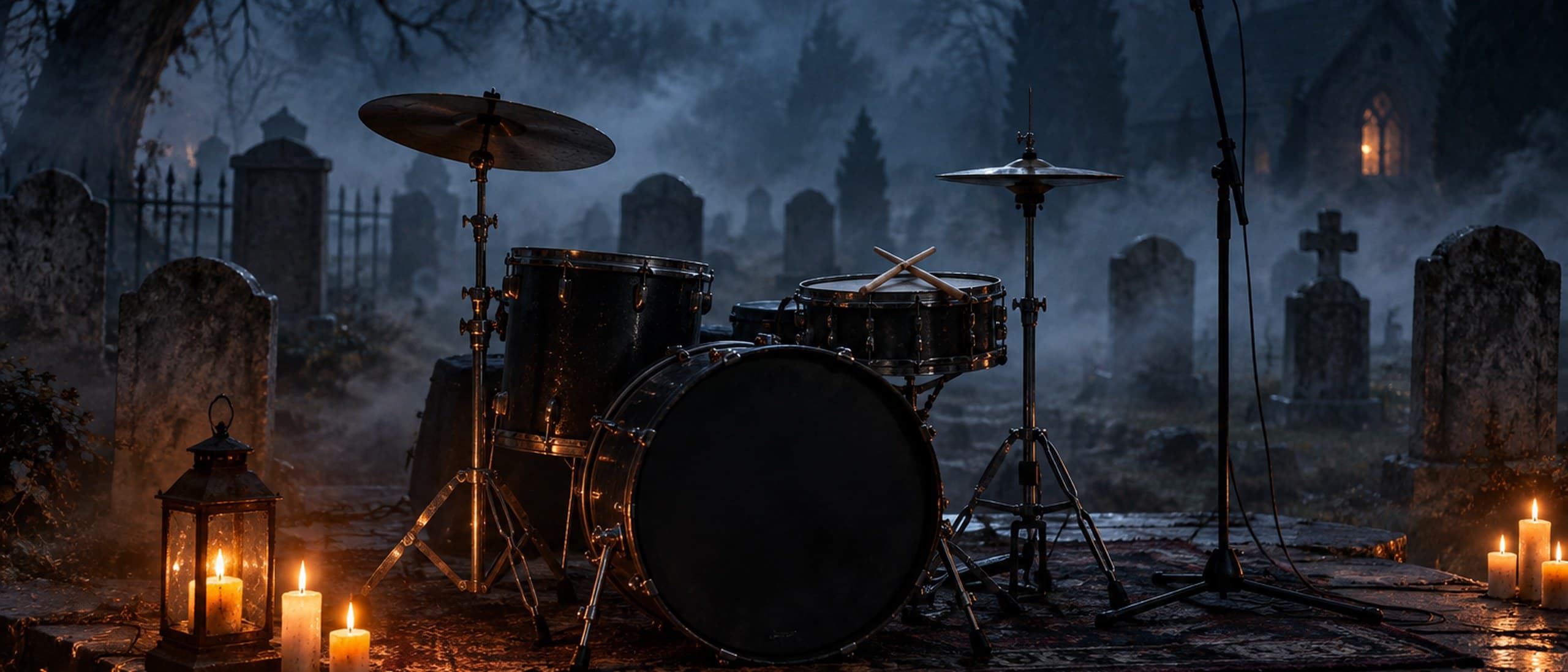
A two-headed skeleton sits behind a drum kit in blue graveyard fog, a top-hatted ringmaster works a crowd of zombies, and a bride with a lantern walks between the headstones while a woman's voice sings the hook: "Wear another face tonight." The video is three and a half minutes long, it went up on YouTube on Thursday 1 October, and it is the 55th public upload from Chris & Crystal AI Art since the middle of May.
Crystal Trimble and her husband Chris Marsh make it look easy, and the craft deserves credit before anything else. The fog transitions are patient, the color stays locked to cold blue with hot orange candlelight, and the lyrics, which Crystal writes, lean into the strange ("Beautiful, but slightly wrong", "Nothing here has to be right if the strange looks good on you"). Their own description calls it an art film. It plays as a music video with no story arc, and as a Halloween music video it is a good one. The more interesting thing is the business it sits inside, and what the rules now say about it.
A channel built on a template
According to the YouTube Data API, the public data feed YouTube offers developers, the channel's uploads playlist starts on Monday 11 May 2026 and holds 55 videos, one every 2.6 days. Those uploads have drawn about 4 million views, with a median of roughly 37,000 per video, and the channel has 56,300 subscribers. The biggest hit, "Creator or Critic" from 17 July, sits at about 549,000 views. The Halloween video had 3,340 views when we pulled the numbers about 16 hours after it went live, well under the channel's median so far.
Every description since Friday 26 June carries the same block, headed "How This Film Was Made": Midjourney and Nano Banana Pro for the stills, Veo 3 for motion "in 4K", Suno for the music "from my lyrics and creative direction", and a human for story, editing, pacing and lighting. Because the block is pasted word for word on every upload, we treat it as the couple's stated workflow rather than a checked tool list for this video. The tag list also names tools they never credit, including Runway, Pika, Sora 2 and Firefly, which reads as search optimization. The 4K claim is plausible, since Google's Veo 3.1 documentation lists native 4K output for 8-second clips, though nobody outside the edit can tell native frames from upscaled ones.
The songs are sold too. The description points to the couple's YouTube store and a Spotify artist page, and the channel bio says they "create all our own original music", lyrics, arrangements and soundscapes included. Under each video sits a legal line: the visuals and music are "fully owned by the creators", and reposting "may result in DMCA enforcement."
What the Copyright Office protects
That legal line is the weakest claim on the page, and it is a common one across AI music channels. The US Copyright Office's January 2025 report on copyrightability concluded that "prompts alone do not provide sufficient human control to make users of an AI system the authors of the output." Its position is that human selection, arrangement and modification can be protected, case by case. On that reading, Crystal's lyrics and the couple's edit are theirs in the full copyright sense, while the Suno arrangement, Suno's generated vocal performance and the Veo motion are much shakier ground, whatever the description says.
Suno's own terms say the same thing from the other side. The September 2026 terms assign paid Pro and Premier users "all of its right, title and interest" in the output, then add that Suno "makes no representation or warranty to you that any copyright will vest in any Output." The terms also warn that output "may not be unique" and that another user can receive the same or similar track. So the couple can sell the song, and Suno will not claim it, but neither of those facts makes the arrangement a copyrighted work they can enforce against a stranger.
The new limits that matter
Two newer rules make the arithmetic tighter. Suno's help center says download limits went live on 3 September: Pro accounts get 20 downloads a month, Premier gets 60, and the free tier gets 7 for life with no commercial rights. Commercial use now attaches to a permitted download, so a track generated but never downloaded is not cleared for sale. At this channel's pace of 11 or 12 new songs a month, Pro still covers it, but any creator posting daily needs Premier or extra downloads. The terms also add a line worth reading twice: "Applicable rights holders may also have the right to collect revenue related to distribution of Outputs on third party platforms." Suno does not say who those rights holders are.
YouTube moved in July. According to TechCrunch's 20 July report on a Creator Insider video, trust and safety chief Matt Halprin said content that cannot be monetized now falls into three buckets, the first being generic, repetitive or template-based content. Halprin also said AI can produce "a higher volume of high-quality content that we want to encourage," and described videos that "don't really have a narrative arc" as the content-farming end. Chris & Crystal sit on the right side of the quality line, in our view, and the visuals change from video to video. A pasted credit block and a fixed upload rhythm are still the signals a reviewer will see first, so the safer move is to make each description specific to the video.
We could not confirm whether the channel is in the YouTube Partner Program. Every upload reports licensed content, which usually means a Content ID claim through a distributor, and their songs are on Spotify. If that is the setup, a Suno-made track is registered as a Content ID asset, which is exactly where the rights-holder clause and the Copyright Office's position meet. The couple have not said, and we have not asked them yet.
What this means if you make AI music videos
In practice, for anyone making work this week, the protectable part of a video like this is the part you did by hand: the lyrics, the shot selection, the edit and the color. Keep dated drafts of those, because they are your evidence of authorship. Download every track you plan to sell and note the plan you were on when you did it. Write a description that says what is new in each video instead of pasting a template, and say "AI-assisted" plainly instead of "fully owned", since the stronger claim is the one a platform or a rival can test. Chris & Crystal have already built an audience on taste and pace. The open question is whether the paperwork under the channel holds up as well as the fog does.
- Date: Jan 2025. What happened: US Copyright Office Part 2 report: prompts alone do not make a user the author; Source: copyright.gov, Part 2 PDF
- Date: 19 May 2025. What happened: Chris & Crystal AI Art channel created; Source: YouTube Data API
- Date: 11 May 2026. What happened: Oldest upload in the public playlist, "Totally Tubular"; Source: YouTube Data API
- Date: 26 Jun 2026. What happened: "How This Film Was Made" credit block first appears; on every upload since; Source: YouTube Data API, 55 descriptions
- Date: 16 Jul 2026. What happened: YouTube names template-based, repetitive AI content as non-monetizable; Source: TechCrunch, 20 Jul 2026
- Date: 17 Jul 2026. What happened: "Creator or Critic" posted, now about 549,000 views; Source: YouTube Data API
- Date: 3 Sep 2026. What happened: Suno download caps go live: Pro 20 a month, Premier 60; Source: Suno help center
- Date: Sep 2026. What happened: Suno terms add no-copyright warranty language and the rights-holder revenue clause; Source: suno.com/terms-september-2026
- Date: 1 Oct 2026. What happened: "Wear Another Face Tonight" posted, 3:28; Source: YouTube Data API