The week your edit suite got an operator
Runway and Adobe put generation inside Premiere and After Effects, and Resolve now exposes itself to outside agents. Every feature is beta or a weekend demo, so the real choice for editors is which bet their workflow has made and what each attempt costs.
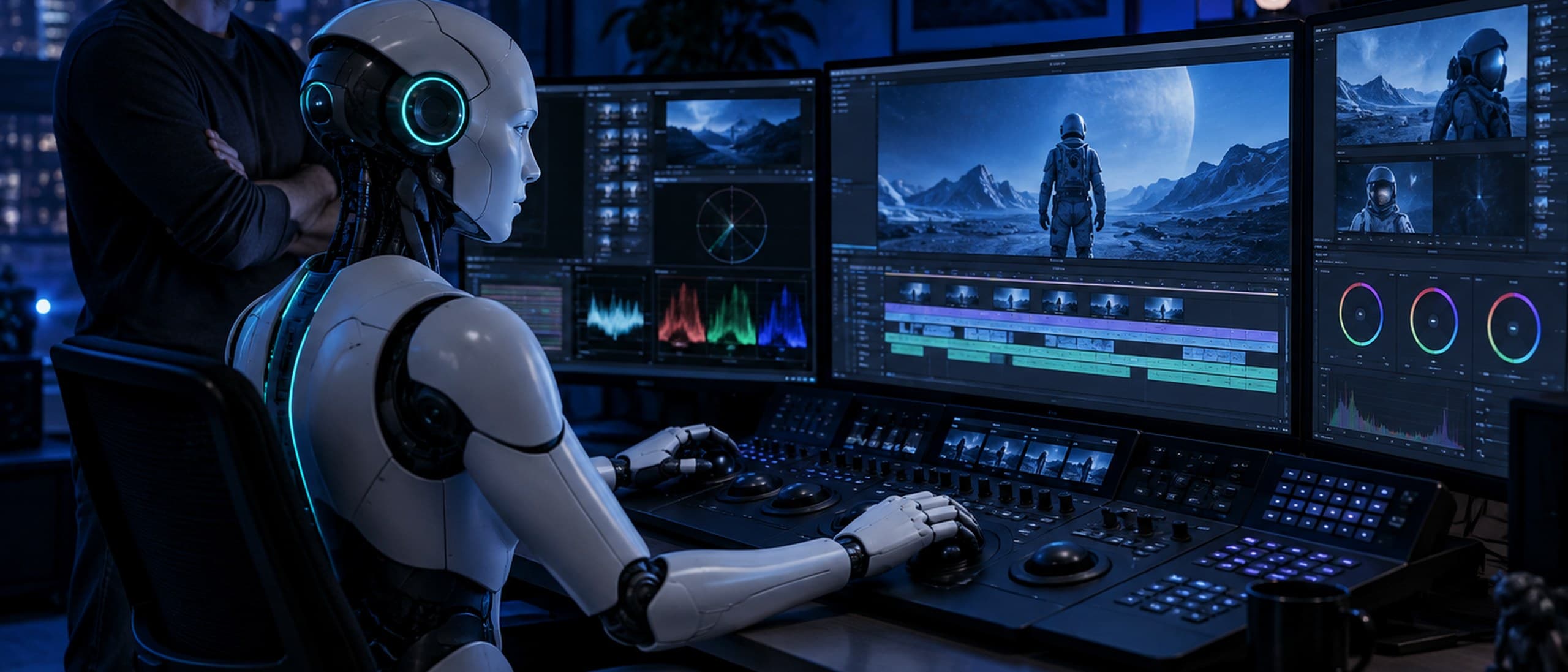
Runway's new Adobe plugin puts a panel inside Premiere Pro and After Effects, where you can generate images and video, restyle footage already sitting on your timeline, and drop the result into the comp without exporting anything. Adobe shipped its own IBC release the same day, putting a generative layer directly on the Premiere timeline and an AI Assistant into After Effects that takes plain instructions, both in public beta. Blackmagic then updated DaVinci Resolve to 21.1 with a native MCP server, which lets an external assistant like Claude or ChatGPT Codex drive the application by typing what you want. Three of the biggest names in post production moved the same lever inside one week, and none of them announced a better model.
What changed is where the software sits relative to you. For two years the generative step lived in a browser tab: describe, wait, download, import, conform, repeat. That round trip was the tax, and it fell heaviest on the work that benefits most from iteration, the fourteenth version of a shot rather than the first. Removing it does not make the models better, it makes the loop short enough that you would actually run it twice.
The weekend evidence
The more interesting material did not come from a vendor. Since GPT-6 Astra landed on 3 September, people have spent their weekends pointing it at the applications they already own, and posting what came out.
Astra writes and executes configuration instructions for Blender, arranging 3D environments, placing assets and setting cameras from a short brief, with the resulting scene reopenable and editable rather than a flat render. Gigazine collected a run of these on 7 September; Simon Willison published a working recipe for driving Blender from Astra in Codex mode on macOS, which is about as close to a reproducible test as this field currently offers. John Nack posted an editor's experiment in which Astra reproduced one of his existing Premiere Pro edits without supervision. Nate Herk reported cutting a full video end to end, avatar and timed audio included, in about 50 minutes for roughly $60 of API billing (about £44 at 0.7383, Wise, 9 September), according to a MindStudio write-up on 5 September. Others describe pairing Astra's direction with ByteDance's Seedance 2.5 for previsualization, generation and grading in one chain.
Treat those numbers as claims, not results. Each is a single operator on a job they chose, publishing the take that worked, and none has been reproduced by anyone independent. What survives the discount is narrower and more useful: the interface these people used was not a prompt box, it was the software, and the model was holding the mouse.
What the people actually running it are saying
The vendor posts are the smaller half of the evidence from that week. The larger half is a few hundred people running it in public over a weekend, and the pattern in what they published is more useful than any release note.
The dominant thread is Astra plus Blender, and it is not a demo genre, it is a pipeline. @TheAIColony posted a chain in which Astra codes the geometry, Blender holds the scene, a clay renderer passes it on, and Dreamina Seedance 2.5 finishes the render. @onihachi rebuilt a forest scene with Astra, Blender and Megascans and reported that it reproduced detail as far back as the guardrail, with the point being editability: "more freedom than video generation," because what comes back is a scene you can go and fix. @KingBootoshi had Astra build a Blender map for a Roblox game, pushed that map through Nano Banana to get variant levels, then fed those variants back to Astra as references. Read across all three and the model is doing setup work while the human still chooses shots and fixes what came back.
The second thread is Resolve, and it arrived with an asterisk the announcements did not lead on. @AlternativeTo summarized 21.1 as expanded multicam and timeline tools, Fusion and color updates, "and moves Python scripting to Studio." @gigazine and @npaka123 both went straight to the MCP integration and drove Resolve from Codex and Claude Code. Nobody in that group is arguing about whether the feature works, they are noting which edition you have to own to get it.
The third thread is the objection, and it is the one worth taking seriously. @MatNiedoba pointed out that while people praise Astra, Fable could already model a complete house in Blender from a blueprint through MCP, with correct measurements and at least comparable quality. A Japanese account making the same point put it more bluntly: 3D was always makeable, so what is everyone shouting about. @chongdashu, mid-experiment porting a game from Unity to Unreal 5.8, switched from Astra to Fable 5.1 for a plain operational reason we will come back to.
Three independent accounts landing on one argument makes it a story rather than a stray complaint, and the precedent objection is correct on the facts and wrong on the consequence. Agent-driven Blender through MCP predates Astra by months, and the people who built those workflows deserve the credit. What changed in early September is not capability, it is default: the endpoint now ships inside a shipping build of Resolve, Adobe put the panel in the app your client already pays for, and the assistant doing the driving is one most of the audience already subscribes to. A capability that needed a hobbyist to wire it up becomes a feature when it arrives switched on.
The bill nobody put in the announcement
Two of these releases are being described as free, and neither is free once you use it the way the demos show.
Resolve 21.1 is a free update, and the MCP server is Studio only. Studio is $295 (about £218), a one-time license rather than a subscription, which is still the cheapest professional software purchase in this story. The line that got less attention is that Python scripting has moved out of the free version, so the free build has just lost the automation route it used to have while the paid build gains a better one. If you are a hobbyist finishing in free Resolve, this update took something away from you and sold it back with a nicer interface.
The Runway plugin is free to download for macOS and Windows, and Runway says generating from the panel requires a paid plan and spends your existing plan credits. Set that against the rate card. Runway Standard is $12 a month (about £8.86) for 625 credits, and Gen-4.5 costs 60 credits per 5 seconds, so the entry plan buys roughly 52 seconds of Gen-4.5 video a month, or about ten five-second generations. The whole argument for a panel inside your timeline is that iteration gets cheap enough to run fourteen times. On the entry plan, fourteen attempts at one shot is most of your month. Pro at $28 a month is 2,250 credits, about 187 seconds. Nobody is being misled here, the numbers are published, but "no more round trip" and "iterate freely" are not the same sentence, and the plugin removes the friction while leaving the meter running.
Astra has the same shape, and this is where the community's receipts are better than ours. @yasutaka_masuda spent around two hours on Roblox game backgrounds in Astra and Blender and burned about half a week's allowance, with 23 percent left until the reset on the 15th. @aicreataro ran Astra into Seedance and back into Blender and posted, cheerfully, that the credits were simply gone. @chongdashu switched to Fable 5.1 specifically because Astra usage was running low. OpenAI's own documentation supports them: Work and Codex usage is included with Plus and Pro, limits apply over a five-hour window and a weekly window, you need allowance in both to keep going, and the published estimate for Astra on Plus is 5 to 45 messages per five-hour window. An agent driving Blender does not send one message, it sends a conversation, so a single scene can consume a meaningful slice of a week.
Set that beside the $60 for 50 minutes claim and the two facts stop competing. API billing scales with use and gives you a number you can quote to a client, while a subscription gives you a wall you hit on a Sunday afternoon with the render unfinished. For anyone treating this as production rather than as a weekend, the cost question is not the price of the plan, it is which failure mode you can survive on a deadline.
Two bets on the same table
Read the vendor releases and the weekend experiments together and you get a fork rather than a trend. Runway and Adobe are betting the assistant belongs inside the application as a panel, subject to its project structure, its undo stack and its render pipeline. Blackmagic's MCP server takes the other side, exposing Resolve as a set of tools that something outside can operate, which is also what Astra is doing to Blender and Premiere without anyone shipping a plugin for it.
Those are not the same product. A panel keeps the human in the chair and shortens the reach to the model, while an MCP endpoint, or an agent that already knows your application, makes the human the person who reviews what the machine did. The first sells to editors. The second changes what an assistant editor is for, and the tasks going first are the ones an assistant editor is usually given to prove they can be trusted: syncing, logging, organizing bins, building a rough selects reel.
Meanwhile Kling AI spent the same week at the Toronto International Film Festival Market, with an industry forum at 11:00 on 10 September at Stage B in the Metro Toronto Convention Centre, a filmmakers' panel titled "A New Creative Paradigm: Consistent, Cinematic AI Video Powered by Kling AI", and an industry reception, each promising an early look at its newest video model. Nobody buys a festival stage to reach editors. That spend is aimed at the people who greenlight, finance and acquire, and it tells you Kling's plan for legitimacy runs through the industry rather than through your timeline. Two strategies, one week: own the tool, or own the room.
What it means if you make things
If you cut in Adobe, your stack changed on 8 September and the honest first move is to test the plugin on a real sequence rather than a demo clip, because a generative panel that fights your project structure costs more time than the tab it replaced. Price one shot before you price a workflow: count the credits a single usable take costs you, multiply by the number of takes you actually need, and you will know within an afternoon whether the panel belongs in a client budget.
If you finish in Resolve, work out which edition you are on before you plan around any of this. Studio at $295 gets the MCP server and the new scripting API; the free build lost Python scripting in the same release, which is a real change if you had automation running.
If you build previsualization or 3D, Astra driving Blender is the cheapest experiment available this month and the Willison recipe beats any vendor demo as a starting point, but read @yasutaka_masuda's receipt first and start early in your usage window, not late.
The caution is the same in all three cases. Every one of these features is beta, first release or an unreviewed weekend claim, and IBC in Amsterdam followed days later with another round of announcements before anyone had finished testing this one. The advantage is not in adopting all of it, it is in knowing which of the two bets your own workflow just made for you, and what it costs you per attempt.