Luma says hybrid production makes underwater shoots accessible. Its own reel shows a swimming pool.
Luma's underwater reel discloses its own input plates, and they are an ordinary pool. That makes it the most honest vendor reel of the month and the weakest cost claim of the month at the same time. The real limit is the 18 second cap on Modify Video input, which the company's own workflow lead says leaves a visible stitch.
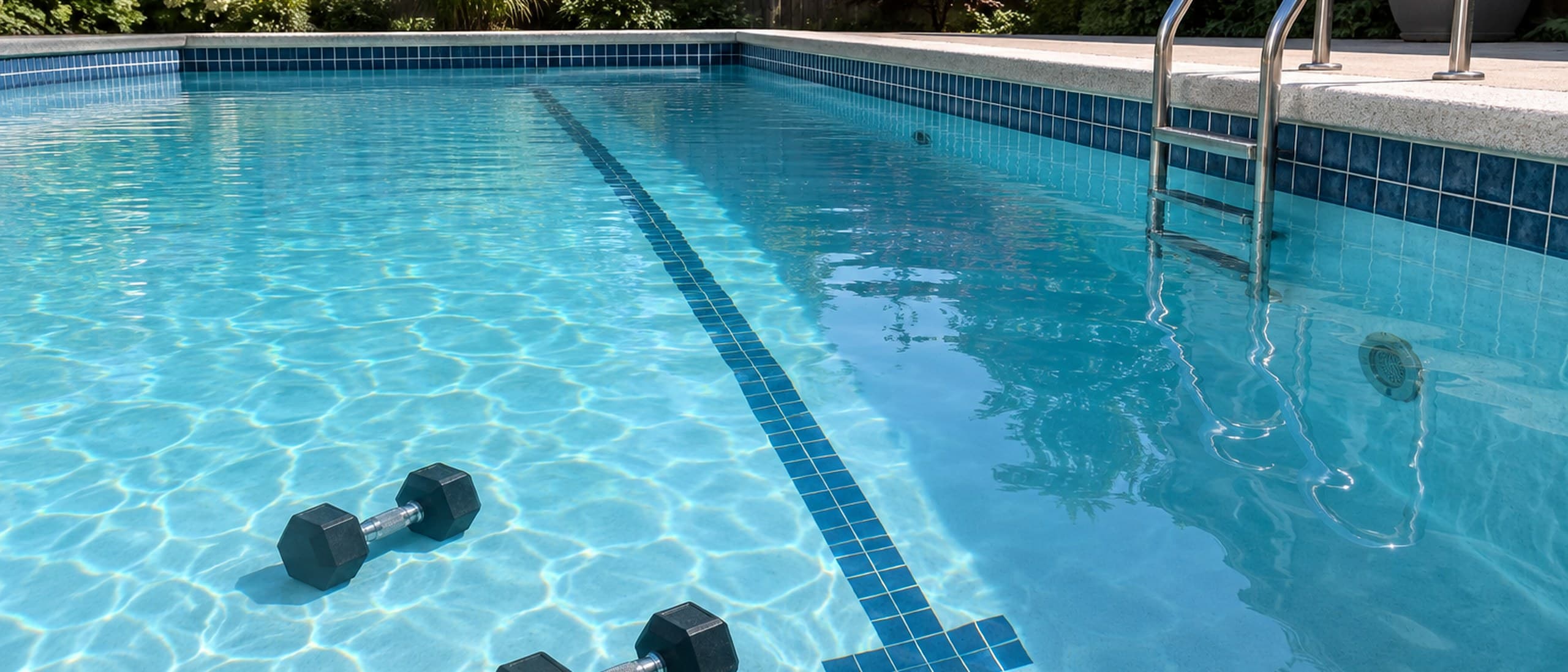
The most revealing frame in Luma's new underwater reel is not the sunken marble hall or the astronaut walking a lunar base. It is the swimming pool. Top of the split screen, labeled "original video," there is a backyard pool with a ladder, a lane rope, tiled coping and a pair of dumbbells sitting on the bottom so the performers can stay down long enough to act. Bottom of the screen, the same bodies move through a flooded village, a flooded library and the surface of the moon.
Luma posted the 57 second reel on Monday 21 September with a claim on top of it: underwater shoots need specialized gear, underwater sets are expensive to build, green screen lighting underwater has problems of its own, and "hybrid production makes underwater shoots much more accessible." The second half of that is a marketing line with nothing attached to it. The first half, the part Luma chose to show, is the most useful thing any video model company has published this month.
The reel shows its own inputs, and that is rare
Vendor reels normally give you the output and nothing else, which leaves you guessing how many takes, how much cleanup and how much of the shot was already there. This one runs the source plate beside the result for four setups: a man falling into a pool becomes a man falling into a drowned street, two breath holding performers become swimmers in a submerged palace, a walk along the pool floor with a dumbbell becomes a walk across the moon.
Read the left column and the economics of the pitch change shape. The water is real in every shot. Nobody asked the model to invent buoyancy, drag, bubbles or the way hair behaves in current, and those are still documented failure modes in video diffusion research, the branch of generative video that builds each frame by clearing away noise, including this year's work on flow supervised training and on underwater light scatter. Keeping a pool in the loop routes around the hardest unsolved part of the problem, which is exactly why the output holds together.
It also means none of the cost items in Luma's own caption were ever in play. There is no housing rig here, no underwater set build, no underwater green screen, no safety diver, no ocean. A pool, daylight, a camera and a performer who can hold their breath. So the reel does not show expensive shots getting cheap. It shows cheap plates getting dressed as expensive shots, which is a different argument and a smaller one, and it is the only one demonstrated.
Who actually made it
The credit line on the post reads "Jon Finger and Luma | Dream Lab." Finger is Luma's Creative Workflow Executive and co-lead of Dream Lab LA, the company's in house studio, which has been running since July 2025 under former CNN and Netflix producer Verena Puhm. This is not a customer result and not an outside filmmaker's test. It is the vendor's studio demonstrating the vendor's model, and every number in the thread should be read with that in mind.
Finger's own timeline is more informative than the marketing post. On 29 August he wrote that he was pushing for longer stable clips and that "the last stitch is the most noticeable." On 26 August he wrote that white walls, green screens and other flat color voids track worse in hybrid work than natural environments, which sits awkwardly beside a caption that offers hybrid as the cure for green screen pain. The practitioner and the pitch reach the same conclusion by different routes, and the practitioner is the one worth quoting.
The eighteen second ceiling is the real story
Luma never names a feature in the post, but the behavior matches Modify Video, the video to video path that keeps the original motion, camera move and performance while replacing environment, wardrobe and set dressing. On the current Ray3.14 model that path takes input up to 18 seconds and 200 MB, runs native 1080p at 24 frames, and comes in three strength modes. The reel's outputs sit at the loosest end, where setting and wardrobe change and the performance does not.
Eighteen seconds is the number to plan around. A 57 second finished piece is several passes cut together, which is precisely the stitch problem Finger described in August. For dialogue free underwater beats that is survivable, because water gives you a natural excuse to cut. For a continuous minute of screen time it is the job. Length, not realism, is where this workflow currently breaks.
Cost lands in the same practical register. Luma's published credit table puts a modify pass at roughly 400 credits for 5 seconds, and the Plus plan at $29.99 for 10,000 credits with commercial rights. One clean pass per shot across a reel this length is about half a month of that allowance, and nobody gets one clean pass per shot. Free and Lite output is watermarked and non commercial, so the tier that is genuinely accessible is not the tier you can sell.
- Date: 4 Jun 2025. What happened: Modify Video launches in Dream Machine, the video to video path this reel uses
- Date: 10 Jul 2025. What happened: Luma opens Dream Lab LA, its in house studio, with Verena Puhm as Head of Studio
- Date: 18 Dec 2025. What happened: Ray3 Modify adds keyframes and character reference
- Date: 16 Apr 2026. What happened: Luma launches Innovative Dreams with Wonder Project and AWS, selling "Realtime Hybrid Filmmaking"
- Date: 21 Aug 2026. What happened: Finger posts that a partner model fights input camera motion and performance adherence
- Date: 26 Aug 2026. What happened: Finger posts that green screens track worse than natural environments
- Date: 29 Aug 2026. What happened: Finger posts that the last stitch is the most noticeable on long clips
- Date: 21 Sep 2026. What happened: The underwater reel goes up, 57 seconds, four setups, pool plates shown
What water actually costs, since the post will not say
Published rates give the comparison Luma skipped. Safety divers run $400 to $600 a day each wherever talent is in the water. Complete underwater camera, lighting and safety packages run $2,000 to $4,500 per shooting day before vessels and permits. One European operator's public breakdown puts a properly made short underwater film, travel, crew, safety and post included, at 15,000 to 40,000 euros.
The craft history says the same thing from the other side. The Little Mermaid shot dry for wet on bluescreen with puppeteers, tuning fork rigs and water trays overhead throwing caustics, because a real tank could not deliver the coverage. Avatar: The Way of Water built a current capable tank and spent about eighteen months inventing underwater performance capture. The expensive part of water was never the water. It was the rigging, the safety envelope and the two minutes your performer can hold a position before surfacing.
A pool plate plus a modify pass deletes the set build and the location. It does not delete the water day. An independently documented hybrid production earlier this year extended a six foot studio pool into open ocean and still reported its actor could tread water for only one to two minutes at a time, with generated wides carrying the scale. The physical constraint stayed exactly where it was.
The version of this you can shoot on Saturday
In practice, for anyone making work this week, strip the marketing and a real method is sitting there in the left hand column, and it is cheaper than anything Luma implies. You need a pool with decent light. Bring weights so your performer can stay on the bottom. Shoot clean, static or slow moving plates in takes under 18 seconds. Design a shot list that never needs an unbroken minute. Then spend your credits turning a municipal deep end into whatever the script actually asked for.
That is a genuinely new capability for anyone who has ever cut a scene because the water day priced it out, and it is worth saying clearly. It is also not what the caption claims. Underwater shoots have not become more accessible. Underwater looks have. Until a funded production puts its name on a sequence made this way, with a schedule and a budget beside it, that distinction is the whole story, and the pool at the top of the frame is the one telling it.
Sources and reporting notes
Primary source is the @LumaLabsAI post of 21 September 2026, read via the X API and again logged out in a browser, with the 57.5 second video downloaded and frame sampled every four seconds; the credit line and reply metrics are from that read. Feature behavior, the 18 second and 200 MB Modify Video limits, strength modes and credit costs are from Luma's own documentation, learning hub and pricing pages. Jon Finger's role and his posts of 21, 26 and 29 August 2026 are from his public profile and timeline. Underwater rates are from the Fixers in Australia marine filming guide (11 March 2026) and a UW Lunatic operator breakdown (24 August 2026); craft precedent from published reporting on The Little Mermaid (2023) and Avatar: The Way of Water; the pool to ocean hybrid example from an invideo production guide, 15 July 2026. No feature name or model version was confirmed by Luma, no independent test of the workflow exists, audio was not assessed, and we hold no license to the reel, so no frame of it is used here.