Minuit: bringing childhood dreams to life through AI
Speaking exclusively with us in her first ever interview, the French artist behind @minuit.art.ia explains how one image becomes a twist-ending fairy tale, why every character gets a design sheet, and what tool partnerships really give her: credits, not pay.
Minuit, the French AI filmmaker who posts short fantasy films as @minuit.art.ia, has given her first ever interview, and she gave it exclusively to The Generated. She explained how one image becomes a twist-ending story, how she keeps a cast consistent across about 25 shots, and why the credits she earns from tool partnerships, rather than pay, set the size of her stories.
Her method is one any AI creator can learn from. She casts characters in Midjourney, builds a design sheet for each one in GPT Image, gives those sheets to Seedance or Kling as references, writes her prompts with a ChatGPT assistant, and cuts the best moments of two or three generations together in CapCut. What this means for AI creators: the twist and the consistency are settled before a single clip is generated.
Nathalie, who works as Minuit, is 49 and lives in a village in the Hérault, in the south of France. She trained in graphic design and at 29 started her own business with Bart, also a graphic designer and her life partner. Her X account, @minuitIA, opened in November 2025 and has 2,302 followers. She is a Kling Elite Creator and lists CapCut, Dreamina and AIST Labs as partners. Her film One Kiss Too Many was our Video of the Day on November 4. Her answers have been condensed and lightly edited for clarity.
Midnight and The NeverEnding Story
How did Minuit begin, and where does the name come from?
My love for fantasy and dark fantasy goes back to my childhood. One of my older brothers introduced me to films like Legend, The NeverEnding Story, The Dark Crystal, Willow, Excalibur, Conan and The Princess Bride.
The name comes from gaming. I'm a passionate player of RPGs and MMORPGs, and I always logged off around midnight, so the other players started calling me Minuit, which means "midnight" in French, and the nickname just stuck!
My journey with AI began when Midjourney first appeared. At the time, a platform called Wirestock organized daily AI image challenges based on different themes. I participated regularly and learned an incredible amount through those challenges.
Then I wanted to bring my images to life. I started making videos with Kling AI, using credits I won in challenges on their platform, and began telling very simple stories, sometimes just 15 seconds long. I'm also very grateful to Kling AI for inviting me to become an Elite Creator. In a way, I'm finally fulfilling a dream I've had since childhood: making my own fantasy films.
One image, then the reversal
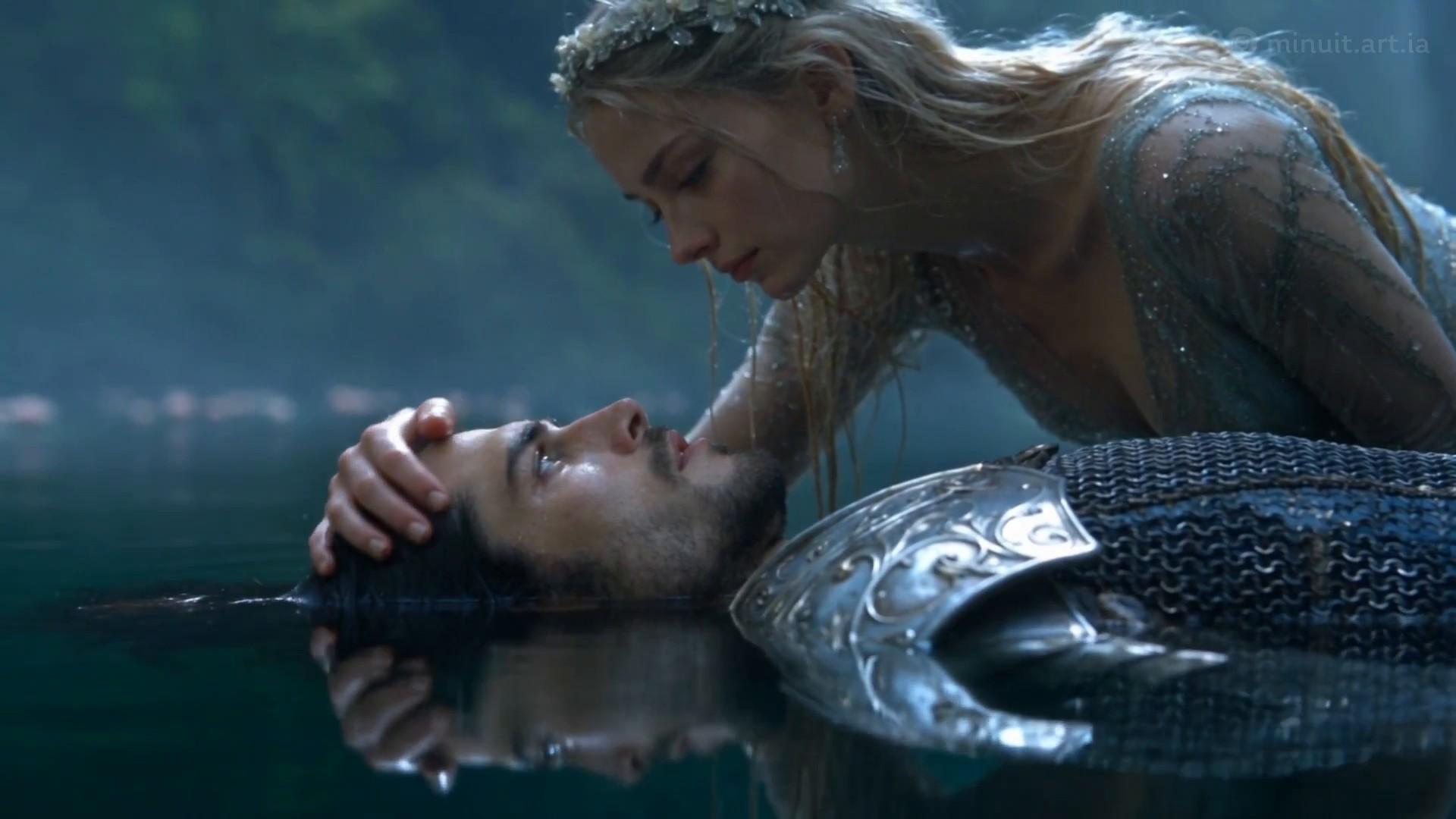
Where Dreams Drown, posted November 1, runs 55 seconds. A knight wades into a lily lake to wake a sleeping princess; by the end it is the knight floating in the water while the princess leans over the knight and says, "You dreamed you were saving me..." Minuit had told us the last 30 seconds came from a single generation, with several shots described in one prompt.
Watch Where Dreams Drown by Minuit on X: https://x.com/minuitIA/status/2116954230154269115
How did that ending come together?
Sometimes I give Midjourney a lot of freedom. I describe the characters, a location and the atmosphere, then let myself be surprised. It's a bit like opening a treasure chest. When I saw the image of a sleeping princess floating on the water, with a knight leaning over her, I immediately imagined a story. At first glance, you assume the knight has come to rescue the princess. But what if it were the other way around?
To create my video prompts, I use a specialized assistant in ChatGPT. For the final 30 seconds, we built a prompt describing several consecutive shots within a single video sequence.
It's very rare to get exactly what you imagined on the first generation! Usually I generate a 30-second sequence two or three times. And when a generation isn't entirely successful but certain moments are beautiful, I keep the best parts, cut the scenes that don't work and assemble everything in CapCut.
The ending comes first
The single-generation ending, then, is a starting point rather than a finished scene: she budgets for two or three attempts and edits across them. Many of her films turn at the last moment. In Witch, Please!, two witches swap the moon for a pumpkin on Halloween night.
How do you build a story that sets up, surprises and pays off in under a minute?
Usually everything starts with an image. Just by looking at it, I often already have the entire story in my head, especially the ending! I love unexpected twists, so I naturally imagine an ending the audience won't see coming.
The length of my films depends a lot on how many credits I have. If I have enough, I'd rather make the video longer and tell the whole story than force it into 30 or 60 seconds. I've occasionally had to shorten a story because I didn't have enough credits, but that's quite rare.
A casting session, then a design sheet
Keeping a character the same from shot to shot is the problem we hear about most from readers. Dragon Nanny, posted November 4, keeps a princess and four baby dragons recognizable across about 25 shots in 60 seconds.
Watch Dragon Nanny by Minuit on X: https://x.com/minuitIA/status/2118065687952273838
What is your method for consistency?
I create my characters in Midjourney first, and I really feel like I'm doing my own little casting! Then I systematically create a character design sheet for each one in GPT Image: multiple views, the full costume, close-ups of the face, different expressions, and all the important details, like accessories, hairstyle and colors.
I use these sheets as references in Seedance or Kling to generate the video. Seedance generally follows them quite well, though occasionally a small costume detail changes from one shot to another. If an inconsistency is really noticeable, I regenerate the sequence. But since I don't have unlimited credits, if the difference is very minor and doesn't interfere with the story, I keep it.
Written in French, scored by Bart
Her films carry English dialogue with subtitles burned into the frame, and most credit Suno for the music.
How do you build the sound of a film?
I always write my dialogue in French, since it's my native language, then work with ChatGPT to refine the lines, the expressions and the characters' tone. For voices, I mainly use Seedance, which generates the characters' dialogue alongside the video, so the voices are there from the creation of the scenes.
For music, sometimes I use the music available in CapCut. Otherwise I turn to my partner, Bart, who is much better at using Suno than I am! I give him the video without music and let him work his magic. Sometimes it's only when I add the music that I truly feel my little film has come to life.
Credits, not pay
On November 7, Minuit wrote on X that her partnerships don't pay her; they give her credits. Two days later she said Kling 4.0 "hasn't really convinced me yet" for photorealistic work, while finding it more interesting for animation.
What does a partnership look like from the inside?
For me, the most important thing is to remain free to tell my own stories. I don't want to turn my creations into simple advertisements for AI tools. I've actually turned down several partnership offers because they didn't fit my creative universe.
The credits are incredibly valuable to me. They let me experiment, retry generations and, most importantly, create longer and more ambitious stories. Without these partnerships, I simply wouldn't have the resources to make as many little stories and fairy tales as I do. That's why I'm genuinely grateful to the platforms that support me, and I'd really like to thank them.
I also believe it's important to be able to express my honest opinions about the tools I use. Just because a platform offers me a partnership doesn't mean I have to pretend that every feature is amazing. A good partnership should be based on trust and creative freedom, not on an obligation to always say positive things about a product. Negative feedback, when it's constructive, is just as valuable as positive feedback. It helps developers understand not only what works well, but also what could be improved.
A hit she can't explain
What she described is an economy most AI creators will recognize: credits are the budget, and the budget sets the runtime and the number of retakes. Reach is harder to plan. Witch, Please!, posted October 29, had 112,905 impressions on X by November 16; the three other films we asked her about drew between 1,225 and 2,651 each.
Why did Witch, Please! travel so far, and do you post differently on Instagram and X?
To be honest, I don't really know why some videos become more successful than others! I post exactly the same videos on both, without adapting the editing or length.
Above all, I'd like to thank everyone who follows me, watches my little stories, comments on them and shares them. It genuinely means so much to me that people take a few moments out of their day to step into the little worlds I imagine. Their encouragement and kindness make me want to keep creating and sharing even more stories. So, a huge thank you to everyone!
One image, many films
Minuit runs weekly challenges on X, and she contributed a piece to The LoopHole Project, a group AI film released on November 7.
Why does community matter to your work?
I absolutely love creative challenges! I think they're fantastic exercises for stimulating our imagination, stepping outside our usual habits and improving our skills. So one day I thought, "Why not organize my own?" The idea is simple: I share an image, and everyone animates it in their own way. What I enjoy most is having fun with other creators. You can learn so much just by seeing what other people imagine, and it's a wonderful way to build a community around a shared passion.
The LoopHole Project worked the same way. We all had the same theme, "Fall. Run. Jump.", and each creator interpreted it within their own artistic universe. I've discovered so many talented artists through these projects that I honestly couldn't choose just one. I'd also like to thank everyone who takes part in my challenges, shares their creations and helps make this community such a lovely place.
Next: Balthazar and Aelis
What would you like to make next, and what would you tell someone making their first short film?
My dream would be to create proper short films lasting several minutes: fantasy fairy tales for children, but also for the big kids we all still are! I also have a project very close to my heart, my own little fantasy series, Balthazar and Aelis. I started developing it several months ago using Grok, but the tools still made it too complicated to bring to life.
Advice? I'm the one who still needs advice! More seriously, I'd tell them to stay true to themselves and create what they genuinely love, without trying to copy others or constantly follow trends. And most importantly, never get discouraged! We all make mistakes, and that's exactly how we learn and improve. I'm still learning new things every single day.
Minuit's stack: Midjourney (casting and images), GPT Image (design sheets and edits), a ChatGPT assistant (prompts and dialogue), Seedance or Kling (video and voices), Suno (music by Bart) or CapCut's library, CapCut (edit). You can follow her on X at @minuitIA and on Instagram at @minuit.art.ia.