Pierrick Chevallier brings a K-pop magazine cover to life with MiniMax H3
French VFX artist Pierrick Chevallier fed two K-pop magazine covers into MiniMax H3 and got 15 seconds of type sweeping in front of, behind and around the models, with sound that hits every cut. He has not shared his prompt or said whether the audio is native, and H3's open weights exclude the US and UK.
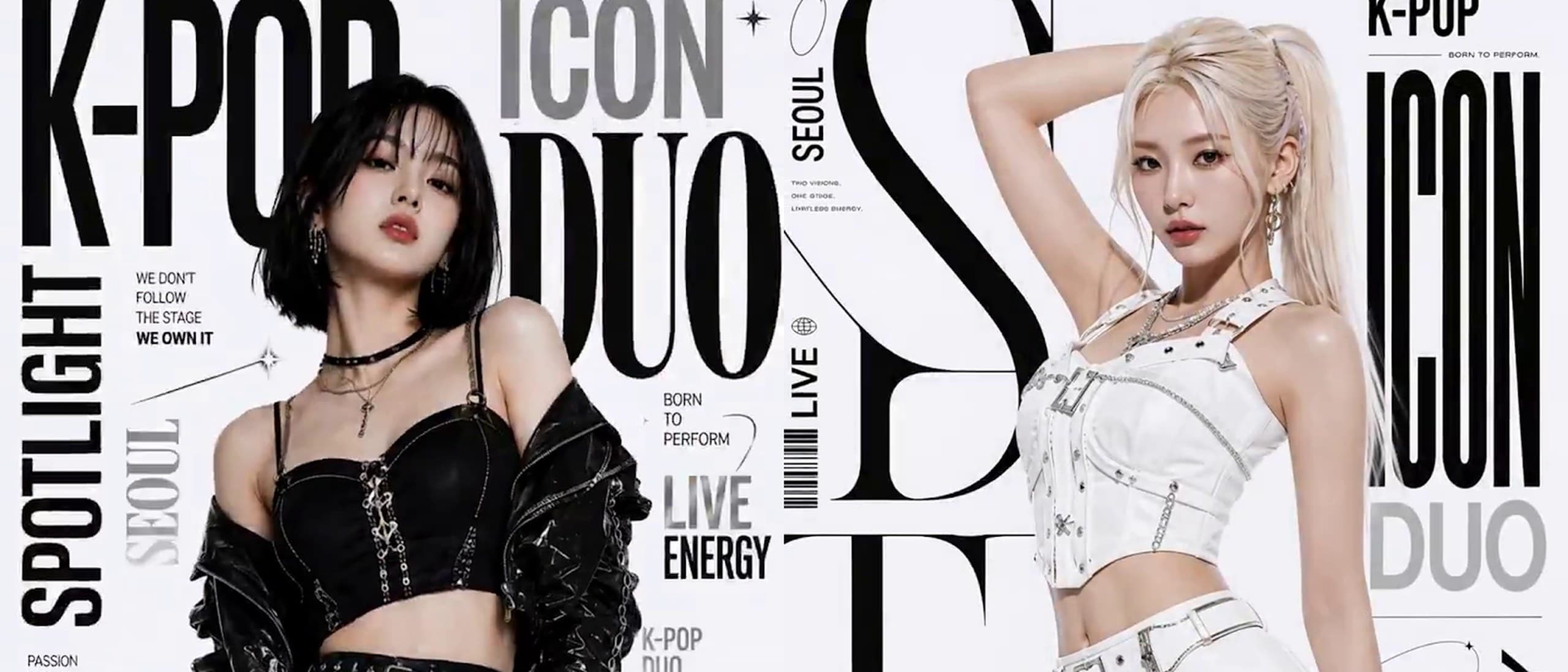
A black-and-white magazine cover snaps into place. "K-POP ICON DUO" runs down the right edge, a woman with a dark bob stands in a black crop top and leather jacket, and then the type starts to move. Giant letterforms sweep across the frame in front of her, a white flash wipes the page, and a second cover builds itself around a model with a platinum ponytail, an oversized serif S rising behind her in silhouette before every word locks back into the layout.
It lasts 15 seconds. Pierrick Chevallier (@CharaspowerAI), a French VFX artist with about 54,500 followers on X, posted it on Thursday 8 October with one tool in the caption: "Minimax H3 is honestly ridiculous for motion design when the source image already includes typography." It is a stunning bit of motion design, and it feels like the cover and hero spread of a fashion magazine have been brought to life.
Type that moves around the people
The type is the main character here. The movement of the type in front of, behind and around the models is pretty much flawless. Letters slide past the first model while she stands full length in the middle of the sweep, the second model is backlit behind a giant S, and when the covers settle every line stays readable, down to the small print that says "TWO VISIONS. ONE STAGE."
Chevallier makes the same point in his own words, saying H3 makes the text "feel integrated into the motion, like it was designed for the sequence from the start." In a reply seven seconds after the post, he shared the two covers he fed in, and the clip opens and closes on them almost pixel for pixel.
From the post alone, it is hard to tell whether the animation is purely the text or the models as well. Going through the frames answers it: the people move too, mostly through generated moments that are not in either cover. The camera snaps in on each face, the first model appears full length among the letters, and the second turns into a silhouette whose arm moves into the final pose.
- Time in the clip: 0 to 2.5s. What happens on screen: A close-up of the first model resolves into the full first cover, then the camera snaps in on her face
- Time in the clip: 3 to 5s. What happens on screen: The first cover holds, every word legible
- Time in the clip: 5.5 to 7s. What happens on screen: Huge black letterforms sweep across the frame in front of her as she stands full length
- Time in the clip: 7.5s. What happens on screen: A white flash hands over to the second cover
- Time in the clip: 8 to 10s. What happens on screen: The second model, in silhouette, behind an oversized serif S as her arm moves into the pose
- Time in the clip: 11 to 11.5s. What happens on screen: A push-in on her face
- Time in the clip: 12 to 15s. What happens on screen: Letters slide past and lock into the finished second cover
Sound that hits on the cut
The on-beat sound design makes you feel like this could be a behind-the-scenes recording straight out of the photo shoot itself. The timing is measurable: the five loudest moments in the track land within a quarter of a second of the five biggest visual hits, from the first face push-in to the final letter slide.
What the post does not say is where that sound came from. H3 generates video with native stereo audio, and this file's audio matches that spec, but Chevallier has not said whether the track came out of the model or was laid in afterwards. He has not shared his prompt either, although one reply asked for it.
What H3 is, and where you can use it
MiniMax open-sourced H3 on 3 August. Its Hugging Face card describes a video model with native stereo audio that makes clips of 4 to 15 seconds, with one mode that works from text plus an optional first and last frame and another that takes up to nine reference images. A clip that starts and ends on two finished covers fits either mode, and Chevallier does not say which one he used.
There is a catch for readers in America and Britain. The H3 community license names the United States, the United Kingdom, the European Union and South Korea as excluded territories for the open weights and their outputs. MiniMax says its hosted API (the paid service developers call over the web) is available globally and that H3 can be tried in its Hailuo app, so the hosted route is the one to check before you take on paid work with it.
In practice, for anyone making work this week, the lesson is in the input. Chevallier designed the type into the still before any motion happened, then let the model treat those letters as part of the scene. That suits posters, key art, title cards and branded visuals, which are the uses he lists himself, and his two reference covers are public, so you can study exactly what he started from.
Who made it
Chevallier describes himself as a VFX artist who tests AI video "in real pipelines" and posts what survives a job. His bio and LinkedIn credit him on the second season of Amazon's House of David, which used more than 350 AI shots, and he runs a French-language YouTube channel, PromptAlchemists, with about 14,900 subscribers.
This clip is the tenth in a run of H3 motion-design tests he has posted since 21 September, from pyrotechnic titles to a web interface. It has also done well for him: about 9,800 impressions by Friday morning against a typical 2,200, with more bookmarks than likes, which usually means people are saving the technique. He labels his brand deals, including his Adobe Firefly ambassador role and paid posts for Dreamina and invideo, and this post carries no paid label or MiniMax tag.
Put simply, it is a beautiful piece of work.
Watch it on Pierrick Chevallier's X post at x.com/CharaspowerAI/status/2108150454269993357, and see his two reference covers in the reply underneath.
Clip and frames by Pierrick Chevallier (@CharaspowerAI), made with MiniMax H3 and shared on X. They are used here with credit. If you are the maker and want any of it taken down, message @the__generated on X and it comes down.
Your Voice
An entire motion design video created with MiniMax H3… and the result is INSANE.
MiniMax H3 is making studio level motion design feel surprisingly accessible now
those kinetic typography beats look like a studio sprint mini max h3 pulling it off
Quoted from public posts on X and credited by handle. If one of these is yours and you want it removed, message @the__generated on X and it comes down.
Got something to say? Tag @the__generated on X