Fox Nation's "all-AI" Houdini series runs on actors wearing new faces
Fox Nation premieres the three-part Houdini: Back from the Dead on 14 October, billed as its first production made entirely with AI imagery. Red Rock Films says actors performed the roles and AI changed their faces, built on licensed archive. The tools are unnamed and the series is not the first of its kind.
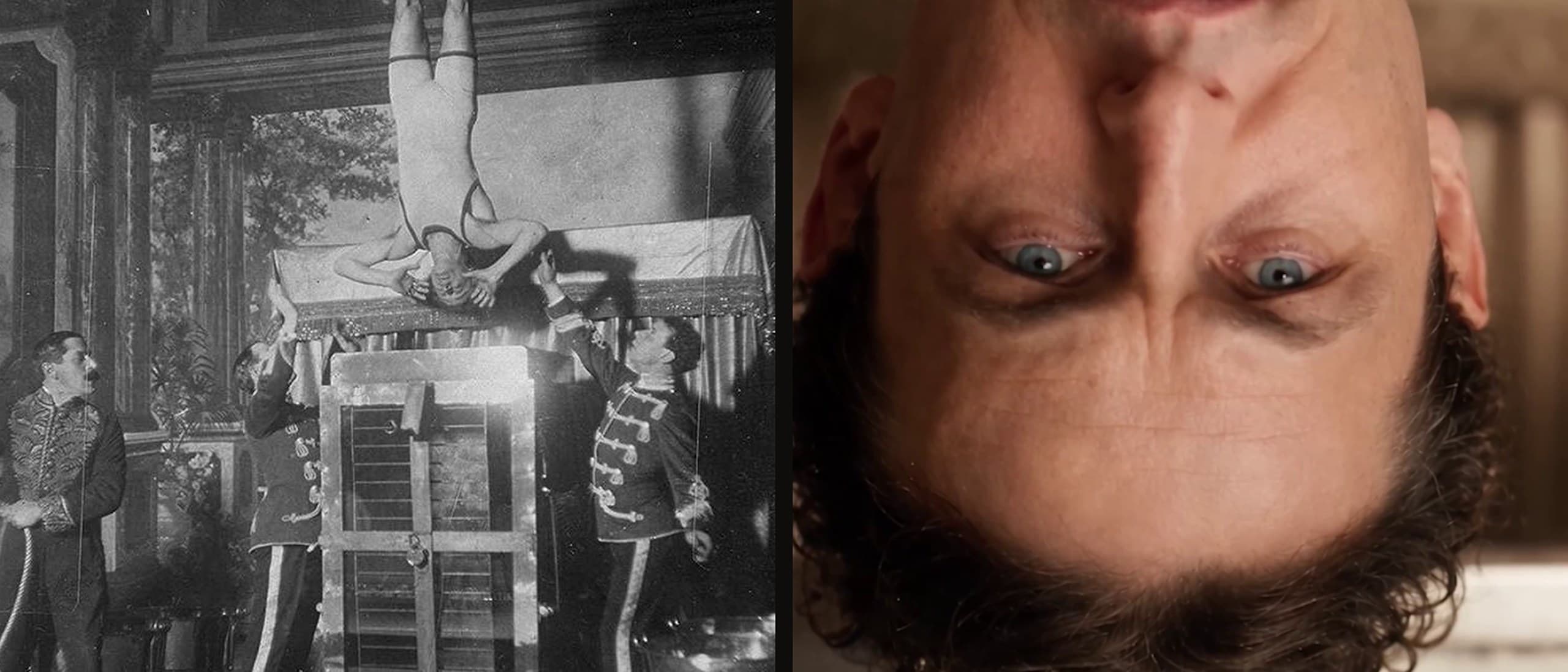
The trailer runs 30 seconds, and every frame of it carries the same small white label: AI GENERATED. A man in a dark suit stands alone on a stage, a woman in a beaded 1920s dress watches from the stalls, a hand claws up out of the dirt, and a man in chains stares into the lens. Near the end, Harry Houdini hangs upside down in his Water Torture Cell, hair floating, eyes open. Over the top of it, a voice announces: "Through the magic of artificial intelligence, I will return to tell you my story in my own words. I'm Harry Houdini."
Fox Nation, the Fox News streaming service, premieres Houdini: Back from the Dead on Wednesday 14 October, two and a half weeks before the 100th anniversary of the magician's death on 31 October 1926. Its announcement on Thursday billed the three-part series as the platform's first full-length, multi-episode production "to rely entirely on AI-generated imagery". The series was produced by Red Rock Films, the Emmy-winning natural-history house behind Secrets of the Whales and Penguin Town, through its AI division, Red Rock AI. Read the release closely, though, and the most interesting thing about the show is how much of it is human.
What "entirely AI" means here
According to Fox's own release, actors played the principal characters "to capture authentic movement, cadence, and performance," and AI then transformed their appearance to resemble Houdini, his wife Bess, his mother, his brother and the rest. The production licensed archival footage and more than 400 historic photographs as source imagery for "a team of AI artists". The scripts, Fox says, were written entirely by humans and checked through archival research and expert review, though no historian is named.
The Hollywood Reporter describes the method as an AI-assisted form of motion capture, with re-enactments and other visuals also generated, and quotes Red Rock's argument for it: the process is less expensive and more efficient than the CGI traditionally used in mo-cap. Variety adds that the characters' voices are a mix of human and AI-generated audio. So the honest description is AI-altered performances built on a licensed archive. That is a real production method with real people inside it, and it is a long way from typing a prompt and getting a documentary.
Whose words are these?
Fox's president, Lauren Petterson, says the series lets viewers "experience Houdini's remarkable life in his own words." The release says the characters speak "through words pulled from diaries, books, correspondence, and historical writings," and in the same breath that the scripts were written by humans. Both can be true, but they aren't the same thing, and the only dialogue anyone outside the production can check points the other way. The trailer's lines ("No stage, no locks, no hidden keys, just me") are promotional copy written for Houdini, not quoted from him.
His actual voice barely survives. The best-known recording is a 1914 Edison cylinder in which he introduces the Water Torture Cell, which means any Houdini voice in 2026 is either an actor or a model built on almost nothing. How much of the three episodes is his written words and how much is dialogue written for him won't be clear until Wednesday.
Not the first, and Fox didn't say it was
Several write-ups have treated the show as a landmark for the whole industry. Fox's claim is narrower and accurate: it's a first for Fox Nation. Sky HISTORY in the UK aired Killer Kings, a six-part series made by the AI studio Gennie, from Monday 16 June 2025, and its producers called it "the first documentary TV series to air using fully AI-generated imagery". Gennie named its tools at the time, including Google's Imagen and Veo 2 and Luma's Ray 2. Red Rock hasn't named any.
That gap stands out because of how Red Rock sells itself. Its AI division says it is "currently making two AI series, each with three 60-minute episodes," that every platform is reviewed before it touches client material, and that "we do not use platforms that train on client content." It also tells clients, "We're transparent about the tools we use." That transparency so far has gone to clients rather than to viewers.
How the audience took it
The early numbers are thin and strange. The trailer on Fox Nation's YouTube channel had 55,629 views by Friday morning but only 26 likes, a like rate of about 0.05%, while the channel's other recent promos run at roughly 2% to 6%. A pattern like that is consistent with paid pre-roll, though we can't confirm Fox bought any. On X, Fox Nation's own trailer post drew about 1,000 impressions and no engagement, and Variety's post about the show collected 32 replies, most of them hostile.
The sharpest reply wasn't about taste. It asked why the production would change the actors' faces at all instead of featuring them, which is a labor and credit question as much as an aesthetic one. Whether those performers are named in the credits is one of the first things to check on Wednesday.
Historical recreation is where the AI work is being bought
In practice, for anyone making work this week, this is the useful part. Factual television has always paid for recreation, and a three-hour network series built on actor-led AI transformation shows where commissioned AI work is landing first: a documentary producer with research, archive licensing and clearances already in place, using AI as a cheaper substitute for motion capture rather than a replacement for the shoot. If you want that kind of job, the archive discipline matters as much as the model.
The legal risk is lower than it looks, and the reputational risk is higher. New York's post-mortem publicity law bars claims brought more than 40 years after a person's death, so Houdini's likeness is effectively open, and we found no statement from his estate or heirs. The question viewers are asking is about credit and consent, not law. The Archival Producers Alliance, whose guidelines are endorsed by documentary makers including Ken Burns, has already written the answer down in its credit suggestions.
- Name the source material used to train any voice model, as a line in the end credits.
- List the software and version used for any generative alteration of archival material.
- Credit the generative AI artists and the performers whose faces and movements carry the piece.
- Disclose on screen as well as in the credits, because the Alliance says credits shouldn't be the only method.
The Houdini trailer already does the last one, with its label on every frame. Whether the episodes keep the label, credit the actors and name the tools are the three things worth checking when the series drops on Wednesday. There's an irony the replies have already spotted, too: Houdini spent his last years exposing mediums who claimed to speak for the dead, and that crusade is one of the subjects the series covers.
Timeline
- Date: 1914. What happened: Houdini records an introduction to the Water Torture Cell on an Edison cylinder, one of the only known recordings of his voice; Source: Slate, 2013
- Date: Sun 31 Oct 1926. What happened: Houdini dies in Detroit; Source: Fox News Media release
- Date: Mon 16 Jun 2025. What happened: Killer Kings premieres on Sky HISTORY, billed as the first doc series with fully AI-generated imagery; Source: Hearst Networks EMEA release
- Date: Thu 8 Oct 2026. What happened: Fox Nation announces Houdini: Back from the Dead; trailer posted to YouTube and X; Source: Fox News Media release, Variety, THR
- Date: Wed 14 Oct 2026. What happened: Three-part series premieres on Fox Nation; Source: Fox News Media release
- Date: Sat 31 Oct 2026. What happened: Centenary of Houdini's death; Source: Fox News Media release
Sources and what is unconfirmed: Fox News Media release (8 Oct), read in full; Variety (Corbin Bolies) and The Hollywood Reporter (Rick Porter), both 8 Oct; Red Rock Films and Red Rock AI pages, read 9 Oct; Hearst Networks EMEA release on Killer Kings (June 2025); Archival Producers Alliance credit suggestions; New York Civil Rights Law 50-f; YouTube statistics for the trailer and the Fox Nation channel and X post metrics, read 9 Oct; frames and a transcript of the 30-second X trailer. We have not seen the episodes. Tools, episode runtimes, performer credits, the share of verbatim Houdini text and whether the trailer views were paid are all unconfirmed, and we did not contact Fox Nation or Red Rock for this draft.
Your Voice
Why do they feel the need to use AI to change the actors' features instead of just featuring the actors? Why take that away from them? It seems like they are using it just for the attention.
I’ve used AI in a recent series. But this trailer is irredeemably terrible. An uncanny valley horror show.
That's horrible. At the very least, I hope they got his estate's permission.
Quoted from public posts on X and credited by handle. If one of these is yours and you want it removed, message @the__generated on X and it comes down.
Got something to say? Tag @the__generated on X