Gossip Goblin's AI feature has a sales agent. The Academy rulebook is the harder sell
Zack London's Gods Don't Give Gifts now has a sales agent, a US date and an Oscar campaign. No US distributor is named, AGC already sold Critterz in May, and the film still has to pass an Academy animation rule that asks for movement created by human means, plus a submission deadline that lands on day three of AFM.
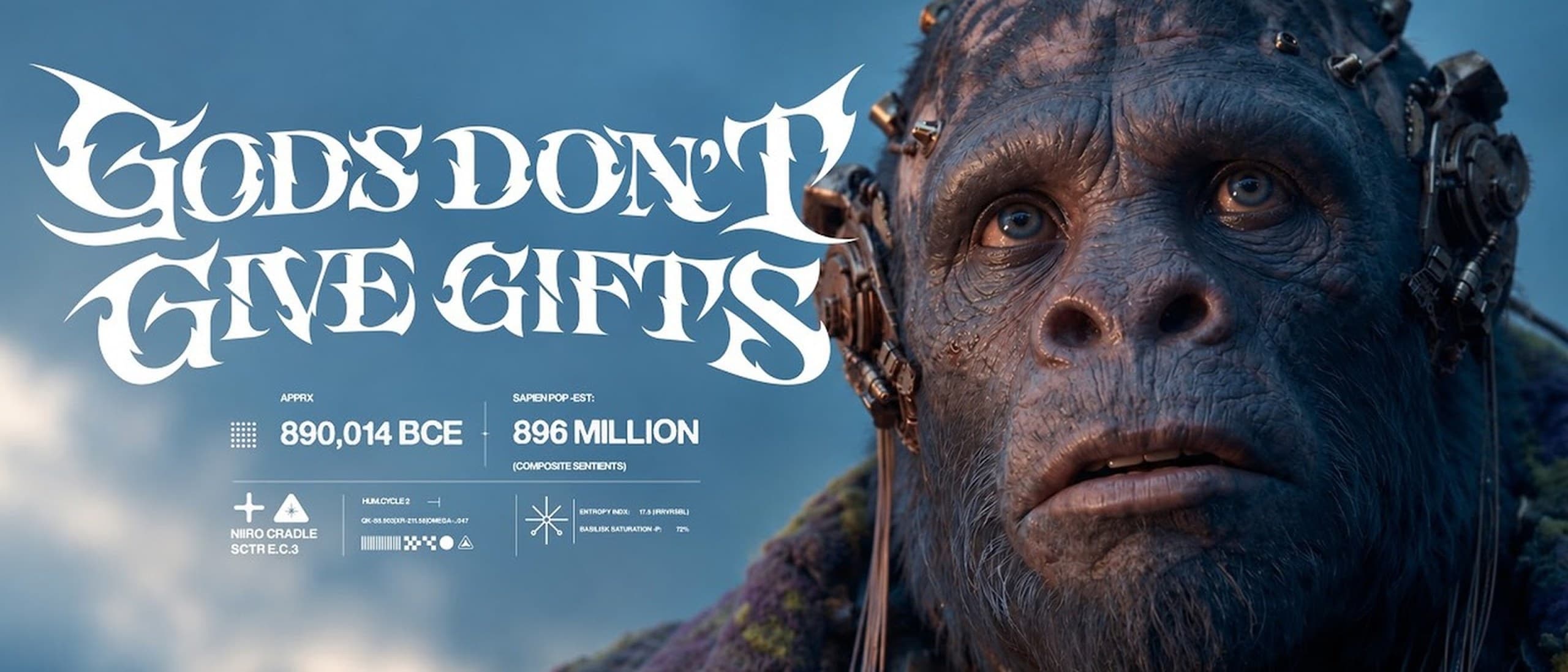
Shortly before half past five in the evening, UK time, on Thursday 22 October, Zack London broke the news to his fans in his own register. Posting on X as Gossip Goblin, the name under which he has spent two years building strange, kaleidoscopic AI shorts on YouTube, he wrote that the film was "coming to theaters December 4th" with AGC behind it, and signed off: "Brace yourselves, goblins, the lore is coming soon to a theater near you!"
Screen and Deadline had already run the story that afternoon, and Variety followed in the evening. AGC International, the sales arm of Stuart Ford's AGC Studios, has added London's debut feature to its slate and will show it to buyers on the first day of the American Film Market, which runs from 10 to 15 November. The film opens in US cinemas on Friday 4 December on under 1,000 screens, and its producers are campaigning for Best Animated Feature.
For anyone making films with AI, this is the interesting part: a creator with an audience and a finished film now has a sales agent, a release date and an Oscar plan. Every one of those still has a gate to pass, and the toughest one is a rulebook the Academy rewrote in May.
What has actually been sold
The three trade stories are one announcement. They carry the same quotes from Ford, London and producer Edward Saatchi, and they went live within about five hours of each other. Read together, they describe a release built by its makers rather than bought by a studio. AGC handles rights outside the US. WME Independent is consulting on the release strategy (Variety and Screen say it handled the US sale, but no US buyer is named anywhere). Deadline is plain about who is putting the film in cinemas: the US release is "via producers Fable and Gossip Goblin." No theater list has been published, and the film's own site says cities are "being announced soon."
Ford framed the deal as a bet on a creator rather than a technology. "A creator who built a devoted global fanbase on YouTube and is now bringing that vision to cinema screens is exactly the kind of talent we want to champion," he said in the release. Saatchi called AGC's backing "a powerful signal to exhibitors and audiences that AI-driven filmmaking when it's executed in the right way belongs on the big screen."
Not the first, and it doesn't need to be
Some early coverage called this the first AI feature carried by a mainstream sales company, but it isn't. AGC itself launched world sales on Critterz, the AI-assisted animated family film with OpenAI's Chad Nelson among its producers, ahead of the Cannes market on Monday 4 May, and Deadline's own story mentions it in its last paragraph. What's new is narrower and still notable: a finished feature that its makers describe as fully AI-generated is on a major sales slate with a US date.
The other firsts deserve their attribution. Variety wrote that the film "will be the first AI film to have a traditional theatrical rollout and awards campaign, AGC said," and kept the attribution, which is right, because a self-distributed run with a booking consultant is not what the trade usually calls traditional. In early October the filmmakers said it was the first AI film to receive an MPA rating (it is listed as R on Fandango), a claim nobody can check because the MPA keeps no category for AI films. Deadline hedged correctly this week with "one of the first fully AI-generated movies to get a theatrical release."
The rulebook it has to pass
We read the Academy's rules for the 99th Oscars, published in May. On AI, the General Entry Rules say generative tools "neither help nor harm the chances of achieving a nomination," and that voters will weigh "the degree to which a human was at the heart of the creative authorship." New this year, screenplays must be written by humans and acting must be performed by humans with their consent. On paper the film fits: London and Jacob Batchelor wrote it, and the release credits a human voice cast and a human composing team.
The animation rule is less settled. Rule Seven defines an animated film as one in which characters are "given the illusion of life by having movement created for them, by any human means," and calls animation "the craft of human creation and manipulation of images." Whether motion produced by a video model counts as movement created by human means is the open question, and the Academy hasn't ruled on it. The release does credit two animation leads and several animators, so the human side of the motion is part of the case Fable will have to make.
The calendar is just as tight. The film needs a seven-day run in one commercial theater in one of six US metro areas, with at least three shows a day, and submissions for films qualifying in the second half of the year close at 5pm Pacific on Thursday 12 November, the third day of AFM. A 4 December opening fits with no slack. The release already moved once for this reason: it was first announced in July for 30 October.
One more rule may matter. A feature loses eligibility if any version of it is shown online before its qualifying run, though up to 15 percent of the running time may be. London's two long shorts set in the same world, The Patchwright (about 21 minutes) and Pomegranate (about 28), were set to private on YouTube by mid-September, and neither is in the channel's public uploads today. Fandango's cast list includes a character called Patchwright. Nobody has said either short is in the 104-minute feature, and Fable hasn't said why they were pulled. If they were cut in, together they would come to almost half its running time.
The audience behind the deal
The release says the trailer has passed 15 million views since 6 October, with no breakdown by platform. The main YouTube upload shows about 2.19 million views. Its like rate is 0.61 percent, the lowest of the 30 videos London has posted since 1 August, where the median is 3.83 percent. A gap that size is consistent with paid promotion, though ad buys aren't public and that is our reading of the numbers, not a finding.
The real asset is the channel. It has about 1.57 million subscribers today, more than the 1.4 million in the release, and most of London's two to three minute world-building shorts since August sit between 400,000 and 3 million views, with one at 7.29 million. That is the audience AGC is pitching to buyers.
How it was made, by their own accounts
London's account in the release is that the film took "10+ months of intense work across a full team of writers, artists, animators, voice actors, musicians, and a trad postproduction crew," and that "AI was a tool to help us tell our story at scale." In July, IndieWire reported it was "made across two months with a team of 10 artists." Both may describe different stretches of the work, but they don't match, and the budget hasn't been reported at all.
The feature's toolstack hasn't been published either. London's own notes on a July 2025 Patchwright short listed Midjourney, Kling, Runway, Veo 3 and others for that piece, which is a guide to his habits rather than a credit list for this film.
The release also doubles as a funnel for the producer's platform. Fable, Saatchi's San Francisco AI studio, which Amazon's Alexa Fund backed in 2025, makes Showrunner, and the film's site runs a fan short-film competition entered through Showrunner Studio (IndieWire reported a $15,000 prize). An ambassador program offers rewards including "your likeness in the Gossip Goblin universe."
What the route looks like for other makers
Read as a map rather than a milestone, the deal shows where an AI feature can go from YouTube, and where it still has to prove itself.
- A sales agent buys an audience first. Ford's quote is about a fanbase, and the channel numbers are what made the film saleable.
- If an Oscar run is the plan, keep long excerpts offline until the qualifying run, because the 15 percent rule counts any version shown online.
- Keep the human paperwork: credited writers, consenting performers and named animators are what the 99th rules ask about when AI is involved.
- Read the terms of any fan contest or likeness reward before you enter, especially when the producer also owns the platform it runs on.
Our take: the sale is real and the first isn't, and that's the better story. The route from YouTube to a cinema screen is now open to an AI maker, but it runs through a self-funded release and an Academy rule that has never been tested on model-made motion. AFM buyers will give the first verdict in three weeks.
Timeline
- Date: Fri 1 May 2026. Event: Academy approves 99th rules: human-written screenplays, human acting, AI details on request; Source: Academy press release
- Date: Mon 4 May 2026. Event: AGC launches world sales on Critterz ahead of Cannes; Source: Deadline; Variety
- Date: Wed 22 Jul 2026. Event: Feature announced for a 30 October US release; Pomegranate short released; Source: IndieWire; Daring Creatives
- Date: Aug 2026. Event: Release moved to 4 December for the awards calendar; Source: Daring Creatives; Futurism
- Date: Thu 17 Sep 2026. Event: Patchwright and Pomegranate shown as private on YouTube; Source: Daring Creatives
- Date: Tue 6 Oct 2026. Event: Official trailer; R rating claimed; awards campaign announced; Source: Deadline; YouTube
- Date: Thu 22 Oct 2026. Event: AGC International boards sales; WME Independent on release strategy; Source: Deadline; Variety; Screen
- Date: 10 to 15 Nov 2026. Event: American Film Market; film screens for buyers on day one; Source: Screen
- Date: Thu 12 Nov 2026. Event: Academy submission deadline for films qualifying July to December; Source: Academy Rule Seven
- Date: Fri 4 Dec 2026. Event: US release on under 1,000 screens; Source: Screen; Fandango
Sources and what is unconfirmed: Deadline (Andreas Wiseman, 22 Oct and 6 Oct), Variety (Leo Barraclough, 22 Oct), Screen (Jeremy Kay, 22 Oct), IndieWire (22 Jul), Daring Creatives (21 Aug, updated 12 Oct), Deadline and Variety on Critterz (4 May), Variety on Fable (Jul 2025); the Academy's 99th General Entry Rules and Rule Seven (May 2026), read in full; YouTube Data API and X API pulls on 23 Oct; the film's website and Fandango listing. Unconfirmed: the US buyer, the R rating on the MPA's own site, the production time, the budget, the E&O insurer and the feature's toolstack. The idea that the shorts sit inside the feature is our question, not a report.
Your Voice
a feature-length AI film with actual human voices doing the acting, aiming at real theaters. the sheer nerve of that. yeah, I'm in.
Your stuff looks cool, makes me uncomfortable as hell though
I like your videos and i hate your videos. I guess i will watch your movie and i will hate it.
Quoted from public posts on X and credited by handle. If one of these is yours and you want it removed, message @the__generated on X and it comes down.
Got something to say? Tag @the__generated on X