Gossip Goblin's AI film wants an animation Oscar, so the Academy must define animation
Fable has moved Zack London's AI anthology Gods Don't Give Gifts to December 4 and will campaign it for Best Animated Feature, forcing the Academy to say whether generated frames count as human animation. No distributor, running time or qualifying run has been announced yet.
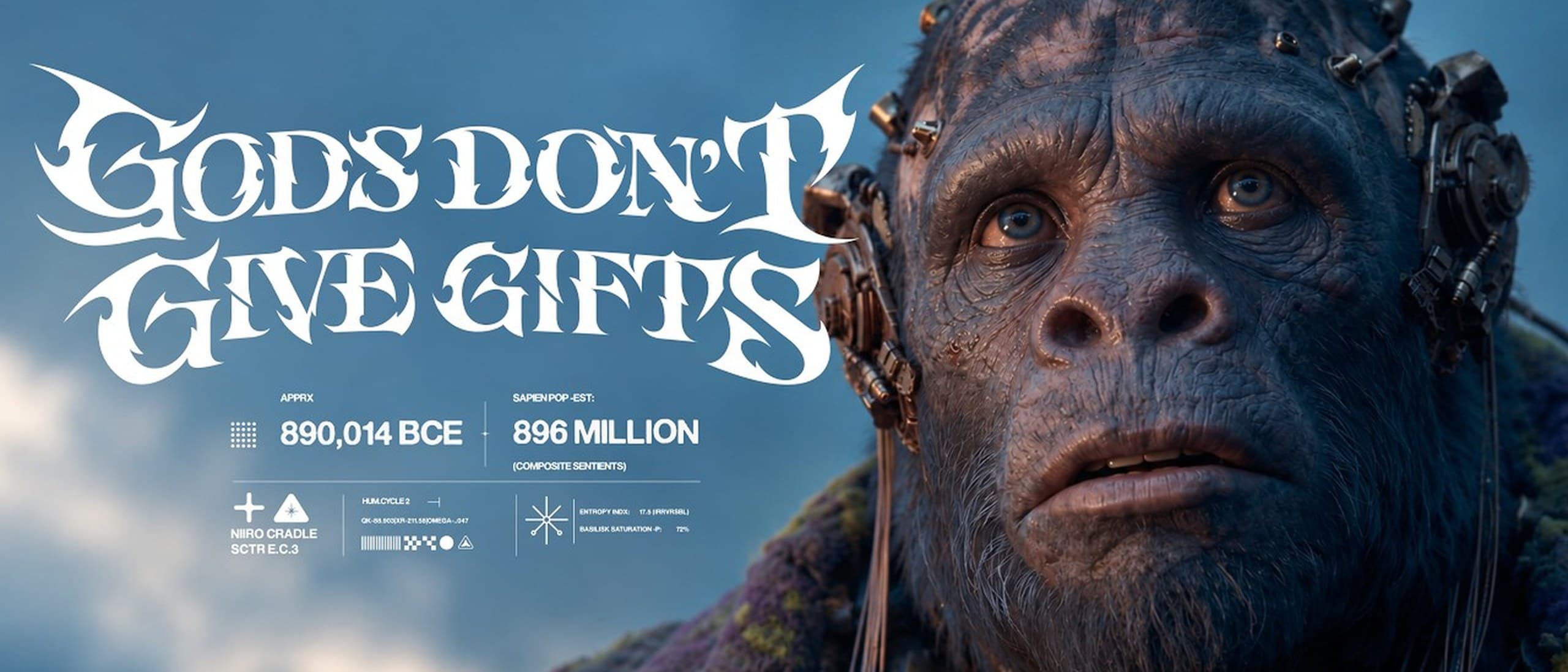
From Friday, October 9, some US moviegoers will sit through a trailer that opens on an ape wired into brass headgear, staring up at a cloudy sky beside a title set in jagged white letters. The film is Gods Don't Give Gifts, an R-rated anthology of four connected stories by Zack London, the YouTuber known as Gossip Goblin, and it is now aimed at the Best Animated Feature race.
Fable, the AI studio run by Edward Saatchi, has moved the US release from October 30 to December 4 to put it inside Oscar season, Variety reported on Tuesday. The plan is a traditional campaign: screenings for Academy voters, previews for critics and billboards across Los Angeles in November. No distributor has been named. Saatchi put it plainly in a statement: "For 5 years, the question has been when will an AI film win an Oscar? Gods Don't Give Gifts is the first that has a shot at a nomination and then it's all to play for."
What the rulebook actually says
The Academy has never had to rule on a feature like this, and its own wording makes the submission interesting. Rule Seven defines animation as "the craft of human creation and manipulation of images to produce a performance from inanimate objects." At least 75 percent of the running time has to animate the primary subjects, the film has to run longer than 40 minutes, and filmmakers must "provide information supporting how the motion picture qualifies" when they submit.
Above that sits the general rule on generative AI, which says the tools "neither help nor harm the chances of achieving a nomination." Voters are told to weigh "the degree to which a human was at the heart of the creative authorship," and the Academy keeps the right to ask for more information about how AI was used. In May it went further for two crafts: screenplays must be human-authored, and acting awards only go to roles "demonstrably performed by humans with their consent."
So the question is not whether AI is allowed. It is whether prompting, selecting and editing generated frames counts as human manipulation of images, and the Animation Branch will have to answer it on paper rather than in a panel discussion.
The human case London will make
London has never hidden the tools. In his statement he wrote: "I made these films with AI, which some people find ironic. But using a medium to interrogate that medium is one of the oldest moves in art." He also argues the label undersells the work. "I don't think it's fair to say it's an AI movie," he said in an interview syndicated on Yahoo, pointing to the human writers, voice actors, musicians and Foley artists on the film.
IndieWire reported in July that a team of 10 artists made the film over two months, with real actors voicing the characters rather than synthetic dialogue. London describes a world designed down to its coffee mugs, alley signs and crab-juice-can labels. That record of human choices is exactly the material Rule Seven asks for, and it is the strongest version of the argument any AI filmmaker has been able to put in front of the Academy.
There are gaps the campaign has not filled yet. Fable has not published the running time, which matters because four shorts only qualify as one feature if they clear 40 minutes together, and it has not announced the qualifying run of seven consecutive days in a single theater in one of six US metro areas. December 4 leaves time for both before the eligibility window closes on December 31.
The theater test comes first
Before any of that, the film has to sell tickets. Fable told the interviewer it will open on fewer than 1,000 US screens, with UK cinemas still in talks, and the model it is chasing is the YouTube-to-multiplex run that turned Backrooms and Iron Lung into box office hits. London has the reach: 1.54 million YouTube subscribers, and a run of two- and three-minute shorts that regularly pass a million views, one of them above 6.4 million.
The trailer is doing well but has not broken out. By Friday morning it had about 724,000 views on YouTube, plus 196,000 on a second upload, against a target Saatchi described as millions. Its like rate sits around 1 percent, roughly a third of what his recent shorts get. Saatchi framed the risk himself: if people treat it "like a normal movie, then it should actually do quite well," and if they treat it as an AI experiment, many will wait for YouTube.
The R rating is not the obstacle it once was in this category, either. Charlie Kaufman's stop-motion Anomalisa, released in 2015, was the first R-rated film nominated for Best Animated Feature.
Key dates
- Date: May 1, 2026. What happens: Academy publishes 99th Awards rules: human-authored screenplays, human performances, AI tools "neither help nor harm"
- Date: July 22. What happens: Release announced for October 30 in limited US theaters
- Date: September. What happens: Film previewed at the Venice Film Festival market
- Date: October 6. What happens: First trailer; release moves to December 4; Oscar campaign announced
- Date: October 9. What happens: Trailer and lobby posters reach US theaters
- Date: November. What happens: Los Angeles billboards, Academy voter and critic screenings
- Date: December 4. What happens: Limited US release
- Date: December 31. What happens: Eligibility window for the 99th Awards closes
What it means if you make work
In practice, for anyone making work this week, the Academy's rules already tell you what to keep. Save the human paper trail as you go: script drafts with authors, voice session records and consent, edit decisions, and the reference art and design work behind each generated shot. If Gods Don't Give Gifts is ruled eligible, that paperwork becomes the template every AI feature after it will be asked to match, and if it is ruled out, the reasons will show where the line sits.
Fable has billed it as the first AI feature headed to theaters and the first with an MPA rating. AI features have premiered in cinemas before, and the rating claim comes from the filmmakers. What is new is a studio putting one in front of the Animation Branch and asking for a ruling. That answer arrives with the nominations, and every AI filmmaker will read it.
Watch the official trailer on Gossip Goblin's YouTube channel at youtube.com/watch?v=1G5LArU7tmE.
Trailer images courtesy of Fable and Gossip Goblin (Zack London), used for news reporting with credit. If you own them and want them removed, message @the__generated on X and they come down.
Your Voice
That one shot alone has me curious. The visual effects look incredible.
Can an AI-made feature compete for Best Animated Feature at the Oscars?
Grimes look alike spotted in a trailer of a new movie; Gods Don't Give Gifts - Only in theaters December 4.
Quoted from public posts on X and credited by handle. If one of these is yours and you want it removed, message @the__generated on X and it comes down.
Got something to say? Tag @the__generated on X