Higgsfield's free AI film school is built on a culture it calls invented
Higgsfield's notes for its 20-minute Arctic drama are a genuinely useful AI filmmaking manual, but no license is stated and the culture it calls invented borrows from real Chukchi, Yupik and Inuit sources with no one credited.
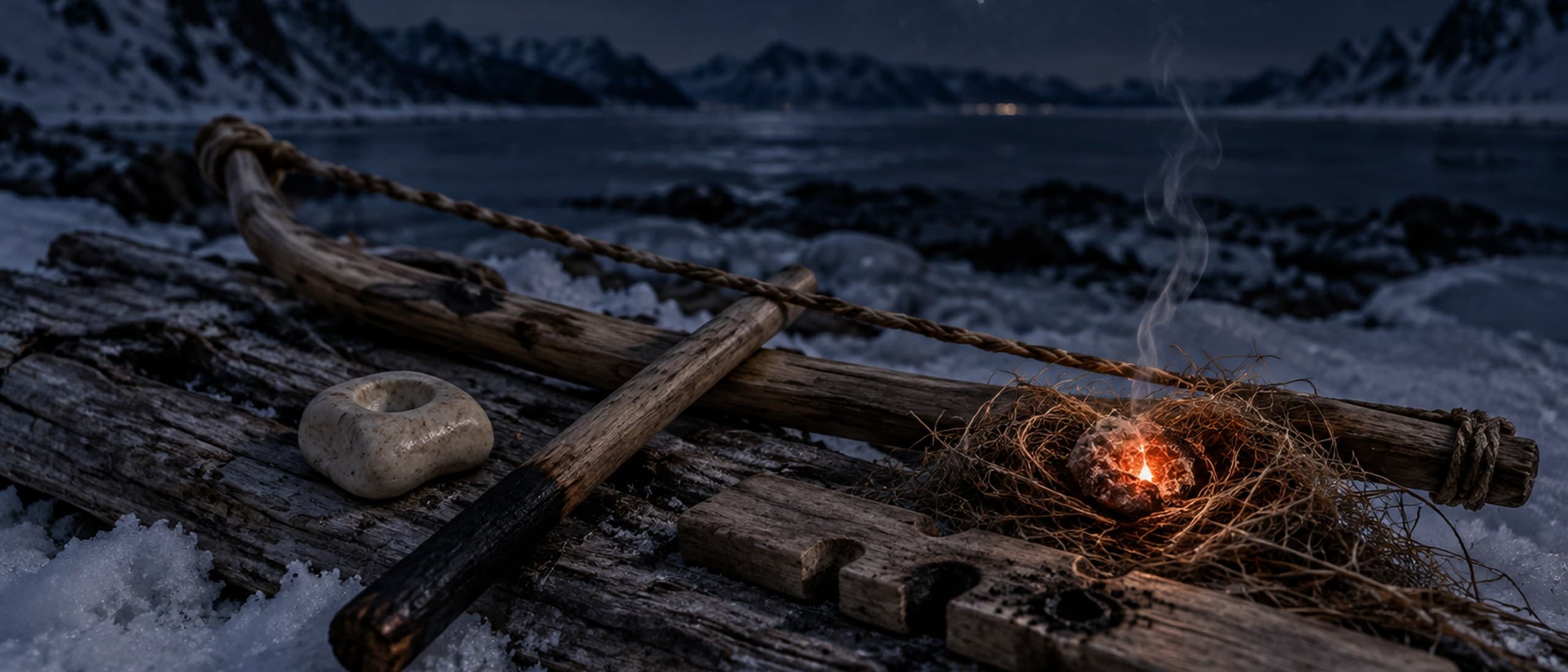
Somewhere in the polar night of ANERNEQ, fire gets made the slow way. Someone scoops a hollow in the snow crust, greases it, sets a bow drill with a twisted rawhide cord and a bone bearing block, and works it until there is smoke, then an ember, then flame. According to the production notes Higgsfield published with the film, its new 20-minute Arctic drama, that sequence is "the best-spent time in the film, because after a scene like that the audience believes the character unconditionally."
Higgsfield released the film on X on Monday 28 September and said it was "now open source. Every prompt and asset is public." What it actually published is more interesting than the label and less open than it sounds: a long, candid production manual for AI filmmaking, attached to a story whose believability rests on real Arctic peoples that the manual describes as an invented composite, with nobody credited for any of it.
A production manual worth reading line by line
The project page, published under the house account higgsfield.studio and created on Thursday 24 September, lists 11,961 generations sorted into scene folders. Seedance 2.5 generated every shot and every line of speech. Claude wrote every prompt from a custom skill file, a reusable instruction document that the page reproduces, and Blender was used for previs, the rough 3D blocking of each shot before anything is generated. The film runs 20:02, and every frame carries a Cinema Studio 4 watermark.
The notes are unusually frank about where AI film breaks. Their thesis is that photorealism is now the easy part and believability is the hard one: "The picture is real, the human in it isn't." So the team spent its effort on objects with a function and actions shown in full, from the fire kit to a stone fat lamp and a walrus-ivory knife that returns as the film's closing rhyme.
The rules that come out of this are specific enough to steal. "Every prompt is an island," the notes say, because the model has no memory, so light, lens, wardrobe, props and voice are written out in full, in a fixed 20-block order, for every single shot. Emotion words are banned in favor of acting tasks: each character gets a goal, an obstacle and a tactic, because "write 'grief' in a prompt and you get a mask." A list of 26 lessons on removing AI tells boils down to one line, "Realism is what you subtract, not what you add," meaning shorter prompts, fewer subjects, darker backgrounds and fewer sharp faces in a crowd. Blender renders are used for framing numbers only, never fed back to the model as an image, because the model starts copying the untextured previs surfaces.
The notes are also honest about the model's limits. Jump cuts are used as documentary coverage, and the team says plainly that they "route around" what video models are worst at, long continuous action. They also claim Seedance 2.5 holds a 65mm anamorphic look from the prompt alone, shot after shot, without baking the lens into a location plate. That claim is Higgsfield's, and nobody outside the company has tested it yet.
The Cyrillic trick
The headline technique is about speech. All dialogue in ANERNEQ is generated on camera, in a language the model has never heard, with no dubbing. The notes say that if you write the spoken line in Latin script inside an English prompt, the engine lays English phonetics over it, with soft vowels, an English r and an English rhythm. Writing the same line in Cyrillic, inside the otherwise English prompt, forces a different articulation. The team calls it "the cheapest and most effective trick of the whole project."
It is a clever, testable idea, and it is still only the vendor's report of its own results. We sampled frames of the film but did not assess the audio, and no independent creator has published a comparison yet. Anyone making work in a language other than English can run the test in an afternoon.
What open source means here
No license appears on the project page, the film page or any of the ten posts Higgsfield published about the film in three hours on Monday. The prompts and generations are viewable on Higgsfield's own platform, whose Terms of Use grant users a limited, revocable license to the service. The X upload of the film ends in roughly 45 seconds of advertising that invites viewers to make a film "like this" with Higgsfield and to submit to Higgsfield Festivals. That is a generous public breakdown and a very good marketing asset, but open source in the usual sense, a license that lets you reuse, modify and redistribute the material, has not been established.
It is also a house format rather than a one-off. In August the metallab.ai newsletter METAL covered Higgsfield's 20-minute ONEIRIC, released with its prompts and assets in the same way, and the company's Original Series page lists around 30 titles. The film is not tied to the company's $1 million Global Film Festival either, since that festival's submissions closed on Wednesday 16 September, eight days before this project was created.
A composite built from real parts
Here is the part the launch posts leave out. The notes describe the characters, clothing, rites and language as "a composite image of a northern culture, not a reconstruction," and say of the dialogue: "We built a language for this film." But the story is set in 1920s Chukotka, the far northeastern corner of Russia, which is home to living Chukchi and Siberian Yupik communities, and the film borrows from them directly.
Several core words of the invented language match entries in a Chukchi-Russian dictionary we checked, including the words for I, camp, tundra, home and blood, and the script uses a letter from Chukchi Cyrillic spelling. Other words do not match, so this is a mix rather than a copy, and a specialist should confirm the details. The title, which the notes gloss as "breath; soul," is the Inuit word anirniq. The destination, the sacred Whale Bone Alley, is a real place: Whale Alley on Yttygran Island, a 550-meter ritual site of bowhead whale skulls and jaws recorded by archaeologists in 1976, where the film stages a death rite of its own invention. The father character is named Rintyn, the name of the hero of Chukchi novelist Yuri Rytkheu's The Time of Melting Snows.
The premise leans on history too. The notes say it "rests on something documented: Arctic hysteria was historically read as spirit possession." Scholars have long treated Arctic hysteria as a diagnosis that European explorers applied, mostly to Inuit women, rather than as settled fact. None of this makes the film illegal, and none of it proves bad faith. It does mean that the realism Higgsfield is selling was built from a real people's words, names, sacred site and material culture, and no Chukchi, Yupik or Inuit consultant, speaker or adviser is credited anywhere in the film, on the page or in the launch thread. The only credit the notes give for the language's dictionary and grammar is to the Claude skill file.
Where the opening is for creators
In practice, for anyone making work this week, the manual is the most useful free AI film education a vendor has published, and every one of its core rules is tool agnostic: lock your assets before your first shot, write every prompt as if the model has never seen your film, direct with tactics rather than adjectives, and cut things out until the frame looks real. Those are directing habits, and they transfer to whatever model you use next month.
The gap in the film is also the opportunity. ANERNEQ's own notes argue that audiences believe behavior and daily life, and the most believable version of that comes from people who actually know the culture on screen. A creator who brings a language speaker, a cultural adviser or a community partner into the credits is doing the one thing an 11,961-generation pipeline did not do, and that is a real way to stand out. The launch post drew 53,100 impressions by Tuesday, well below the 100,000 to 814,000 of the company's recent product launches, and we found no independent review, so the conversation about this film is still open. Higgsfield has not said who directed ANERNEQ, how many people worked on it or whether anyone from Chukotka was consulted.
Timeline
- Date: Mon 10 Aug 2026. Event: Higgsfield Global Film Festival opens, $1M across 14 placements; Source: Festival official rules
- Date: Thu 13 Aug 2026. Event: METAL reports ONEIRIC, 20 minutes, prompts and assets published; Source: METAL
- Date: Mon 17 Aug 2026. Event: Higgsfield raises $400M at a $5.4B valuation; Source: Reuters
- Date: Wed 16 Sep 2026. Event: Festival submissions close; Source: Festival official rules
- Date: Thu 24 Sep 2026. Event: ANERNEQ project page created; Source: Higgsfield project page
- Date: Mon 28 Sep 2026. Event: Film launched on X, nine follow-up posts in three hours; Source: X API
- Date: Tue 29 Sep 2026. Event: 53.1K impressions on the launch post, no independent review found; Source: X API
What is still open
We have not established whether the generations can be downloaded or reused without an account, or under what terms. Higgsfield names no director, writer, editor or sound designer, and it has not said whether any Chukchi, Yupik or Inuit person was consulted. The generation cost is not published. The Cyrillic technique and the 65mm claim are untested outside Higgsfield. The dictionary matches rest on one online Chukchi-Russian dictionary and need a specialist check before any word-level claim is printed.
Sources and reporting notes
The production notes were read in full on Higgsfield's public project page, logged out, on Tuesday 29 September. Launch and engagement figures come from the X API on the same day, and we downloaded the X upload and viewed sampled frames, including the full final minute. Festival dates come from Higgsfield's official rules and the license position from its Terms of Use. ONEIRIC comes from METAL and funding from Reuters. The language checks used the zorinanata.ru Chukchi-Russian dictionary and the Inuinnaqtun-English Dictionary, the Whale Alley details come from the Penn Museum's Expedition magazine, and the Rintyn name was confirmed in Rytkheu's novel.