Hollywood's showcase AI soundstage is nine people, co-launched by Luma, and open for hire
Innovative Dreams, the AI soundstage Variety used to open its Open to AI feature, was co-launched by Luma and is backed by AWS, neither of which the piece mentions. It has nine staff, one finished show and no named outside client yet, and the feature's one hard number on cost is a producer estimate whose baseline has moved.
Stage 21 sits on the same Manhattan Beach Studios campus as the LED volume where the Mandalorian series was shot and the Lightstorm offices where James Cameron builds Pandora. Inside, according to Variety, Bryan Yee sips from a Diet Coke can while he shows a visitor a wall of LED screens where a team of AI artists weaves generative imagery into productions. Yee is the chief operating officer of Innovative Dreams, the company that runs the stage, and Variety concedes the visit was a repeat: "It's not the first time the space has been shown to a journalist."
That stage is the opening image of "Open to AI", the long feature Variety published on Tuesday arguing that AI is no longer Hollywood's ultimate bad word. The piece calls Innovative Dreams an AI offshoot of director Jon Erwin's company Wonder Project. It never mentions that Luma, the AI video company, co-launched Innovative Dreams with Wonder Project in April, or that Amazon Web Services backs it. About 85 minutes before the feature went live, Luma posted its own clip from the same floor, signed off "Shot at Innovative Dreams" and "Made with Luma".
What an AI soundstage actually is
Wonder Project and Luma announced Innovative Dreams on Thursday 16 April, describing it as a production services company, R&D lab, post-production house and visual effects firm in one. Its method has a trademark-ready name, Realtime Hybrid Filmmaking, which the launch release defines as performance capture, virtual production and visual effects with generative AI at every stage from concept art to post. Virtual production here means actors performing in front of LED walls that display the background live, so they can see and react to the world they are supposed to be in. The generative layer builds and restyles those worlds.
The company behind it is small. Erwin is its CEO and it runs as a standalone business inside Wonder Project's studio division. Its LinkedIn page lists nine people, and Yee, who joined as COO in November 2025, describes himself as the second employee and the company as "backed by Luma AI and Amazon AWS". Erwin's launch line called it "what we believe is the industry's first final pixel, gen-AI-enabled, production-ready workflow applied at scale", a superlative that nobody outside the company has tested.
One week, about 100 crew, one Ben Kingsley
The stage's first job was The Old Stories: Moses, a three-part companion special from the world of House of David, with Ben Kingsley and O-T Fagbenle, shot entirely on a virtual stage and released on Wonder's subscription channel on Prime Video in May. The Los Angeles Times reported that it was filmed in one week with about 100 crew without leaving Los Angeles, a figure no other outlet has independently confirmed. Which Luma tools went into Moses is still not public: the launch release names Luma Agents as part of the collaboration, not as something used on the show.
The one review we found was not kind. Religion Unplugged called the special artistically underwhelming in June. That is one critic in the faith press, so treat it as a data point and leave the verdict open.
What Luma's clip shows
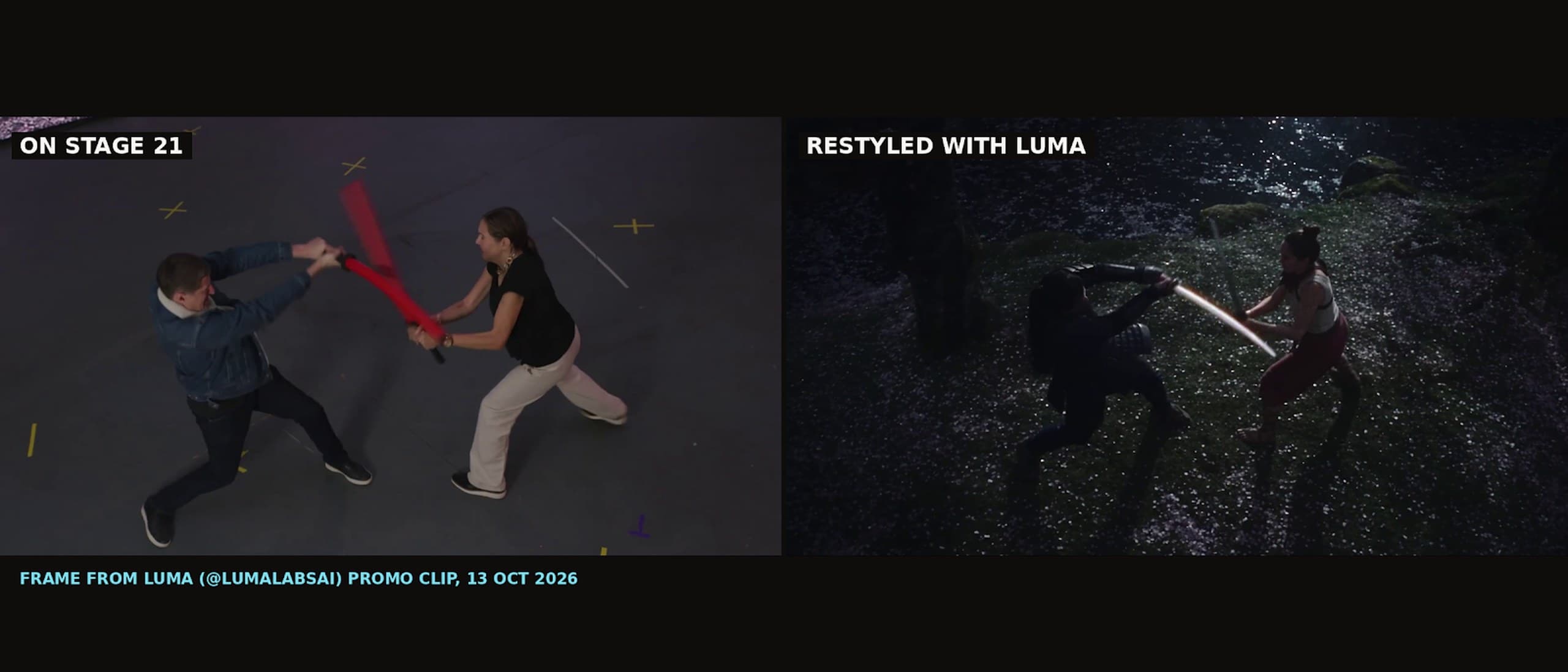
We pulled Luma's 13 October clip and watched it frame by frame. It runs 17.7 seconds as a split screen. The top half is raw footage from the stage, with Jon Finger, Luma's creative workflow executive at its Dream Lab LA studio, sparring with a woman the post identifies only as Laura, both swinging red prop swords on a gray taped floor in front of an LED wall of cherry blossoms. The bottom half is the same take restyled by Luma into an armored fighter and a swordswoman in a night forest.
It is a fun demo, and it is a vendor promo starring a vendor employee, so it is not production footage or outside proof of anything. It drew 5,959 impressions, close to the account's usual reach that week. Luma has been running a small campaign around the stage, too. On 9 October it posted that Erwin "made Moses on a stage in Manhattan Beach, with real actors and AI carrying them into any world the story needed."
The feature's only hard number has moved
Most of "Open to AI" is mood: Soderbergh defending his AI material in John Lennon: The Lost Interview, Katzenberg on his new AI animation studio, Lionsgate's Kathleen Grace on leading with the story rather than the tool. The only hard figure comes from producer Ryan Kavanaugh, who told Variety his firm Acme cut the cost of Doug Liman's Bitcoin from $200 million to $70 million with AI, and its below-the-line costs from $130 million to $35 million.
Six months earlier the starting figure was bigger. During a set visit in March, Kavanaugh told TheWrap: "We budgeted out what it would be to do it practically and it was over $300 million." Both numbers are the producer's estimate of a film that was never going to be made the expensive way, and nobody has audited either. The $70 million may well be real, but the saving depends on which imaginary budget you start from.
The audience read it as an ad
Variety's post of the feature on X has 39 quote posts. Across the outlet's last 100 original posts, the median is one. The top replies call it a puff piece and ask who paid for it. We saw no sign that anyone did. The plainer problem is the one none of those replies spotted: a feature about Hollywood warming to AI opened on a stage co-owned by an AI video company and did not say so.
Where the opportunity sits for creators
The feature closes on an unnamed studio executive drawing a line between industry professionals and "the online video slop made by people without industry experience." The stage Variety used to open the story is a nine-person company running a method that independent AI filmmakers have been building outside the studio system: real performances, generated worlds, decisions made on the day.
In practice, for anyone making work this week, the launch release is the useful document. It says Innovative Dreams will take third-party work "across a wide range of genres and budget levels" and will act as an education hub for filmmakers, showrunners and producers. No outside client has been named yet, which means the door is still being built.
- Your hybrid reel is the pitch. Performance shot against a plate and restyled with a model is the exact workflow this stage sells to studios, so a tight before and after cut speaks its language.
- Who owns a stage shapes its toolbox. A stage co-launched by Luma will lean on Luma, so it is worth asking any stage which models it runs before you plan a shoot around it.
- Your own budget math should hold up. Producers' "would have cost" numbers drift, and a real line-item comparison from your own project will travel further than a counterfactual.
The open question is simple: who is the first client from outside Wonder Project to shoot on Stage 21, and will anyone say which tools they used?
Timeline
- Date: Nov 2025. What happened: Bryan Yee joins as COO, the company's second employee; Source: Yee LinkedIn (self-reported)
- Date: Mar 2026. What happened: Bitcoin set visit: Kavanaugh puts the practical budget at over $300M (published Wed 15 Apr); Source: TheWrap
- Date: Thu 16 Apr 2026. What happened: Wonder Project and Luma launch Innovative Dreams, backed by AWS, stage at MBS Media Campus; Source: Luma release; Deadline
- Date: Wed 13 May 2026. What happened: Moses profile: shot in one week with about 100 crew; Source: Los Angeles Times
- Date: Thu 11 Jun 2026. What happened: Moses review calls it artistically underwhelming; Source: Religion Unplugged
- Date: Fri 9 Oct 2026. What happened: Luma post: Erwin "made Moses on a stage in Manhattan Beach"; Source: @LumaLabsAI on X
- Date: Tue 13 Oct 2026, 13:35 UTC. What happened: Luma clip "Shot at Innovative Dreams" with Luma staffer Jon Finger; Source: @LumaLabsAI on X
- Date: Tue 13 Oct 2026, 15:00 UTC. What happened: Variety publishes "Open to AI", Luma and AWS not mentioned; Source: Variety
Your Voice
Three-quarters into 2026, AI is no longer Hollywood's ultimate bad word. From a Tribeca premiere to a $70 million blockbuster, the industry is quietly rewriting its own rules on what's acceptable on screen.
I understand the fear that many in the business and wider culture fear…but these tools are being used and integrated in our pipelines.
Hollywood is embracing ai. Scorsese, Witherspoon, Lucas, Katzenberg building an ai animation studio.
Quoted from public posts on X and credited by handle. If one of these is yours and you want it removed, message @the__generated on X and it comes down.
Got something to say? Tag @the__generated on X