Katzenberg says the AI fight is about the terms. He just didn't write any
In a roughly 2,400-word post on X, Jeffrey Katzenberg asks AI developers for credit, consent and compensation and tells Hollywood to negotiate. He proposes no rate, license or opt-out and does not disclose WndrCo's AI video bets or the video-model company he is reportedly forming. The real terms have dates: animation's contract expires in July 2027.
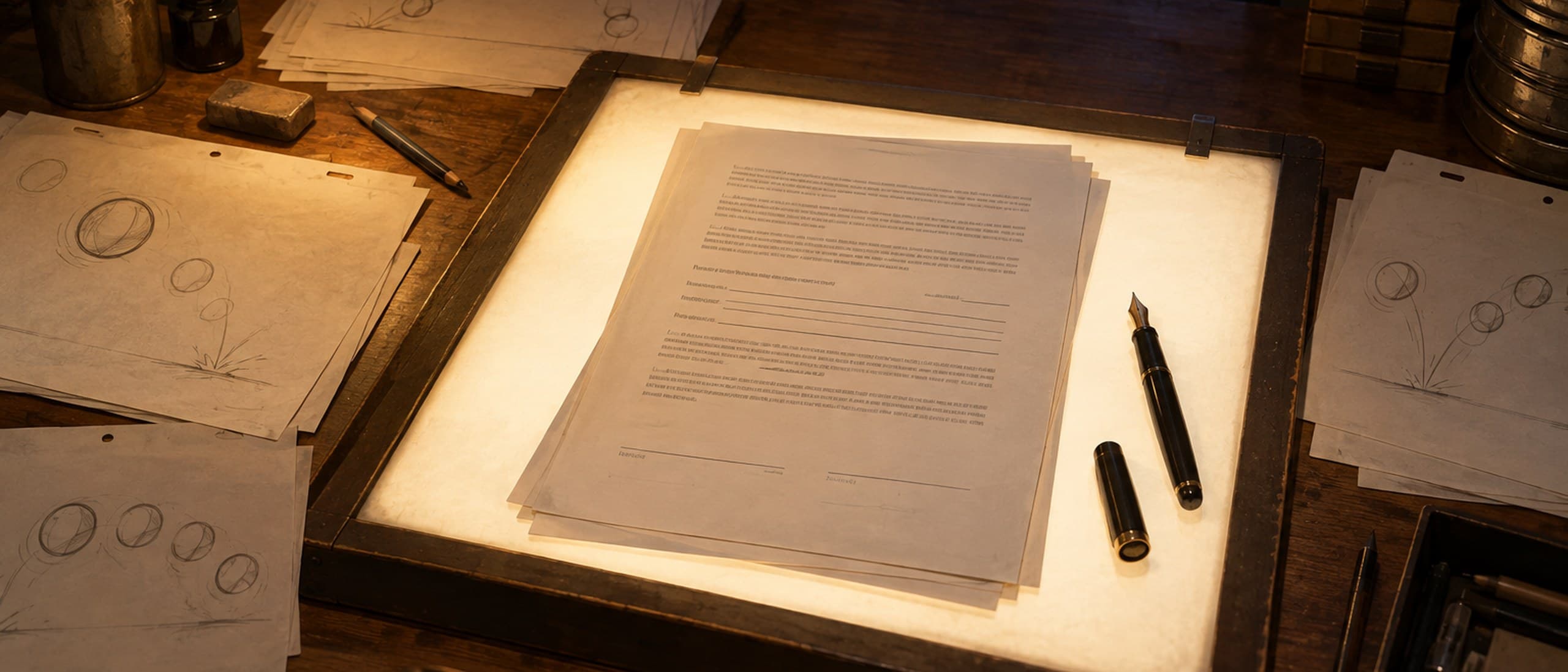
A few months ago, by his own account, Jeffrey Katzenberg sat in his Silicon Valley office while a tech founder showed him a fully realized, beautifully lit animated scene, and it made him feel what he felt watching Pixar's desk-lamp short in 1986. Later that day an artist he had known for thirty years texted him from Los Angeles after seeing a similar clip. "Is this the end of us?" she asked, and he told her certainly not. On Wednesday 23 September he posted the long version of that answer to X, a roughly 2,400-word essay called "The World is Changing: AI For Creativity", the only post his account has ever made.
The argument fits in a few sentences, and he wrote them himself: "Hollywood needs to accept that AI is not going away. The energy they are spending trying to make it disappear is energy they are not spending deciding the terms on which it will exist. And the terms are everything." He closes on the line the trades picked up: "The tools-versus-no-tools argument is a trap. First, we must all agree that there should be terms. Then we can have the crucial debate about what fairness requires."
Much of the reach was borrowed. Elon Musk quoted the essay 36 minutes after it went up ("Thoughtful piece by Jeffrey Katzenberg"), and his quote alone drew 6.81 million impressions against 8.07 million for the essay itself, according to X's own counts on Monday. Variety and TheWrap largely transcribed it, while Cartoon Brew was sharper, writing that he "offers little explanation of how those gains would translate into work for artists."
What he actually asks for
Read in full, the essay asks each side for one thing. Of the people building AI, he wants artists included "by design, with credit, with consent, and with compensation," and he turns it into a slogan: "Build this with the storytellers. Not on top of them." Of Hollywood he wants acceptance and a seat at the negotiation. He does not propose job protection, which some early summaries credited to him, and he is unusually frank that jobs go. Of the orchestra musicians displaced when sound came to the movies, he writes: "They were right. Those pit jobs did not come back." DreamWorks' exit from hand-drawn animation, he says, "cost talented people their place", and some of them never made the leap.
What the essay does not contain is a single term. There is no licensing model, no rate, no opt-out, no position on training data that has already been scraped and no view on any union contract, because the fairness debate, in his own sequencing, comes later. Even his sharpest distinction, that AI handles reasoning while Hollywood does the creating, is an answer he says he got by asking "one of the leading AI models" and pasted in as two paragraphs. Eric Stevens, an advertising creative, pointed out on X that "the reasoning machine wrote the best part."
The interests the essay leaves out
The essay mentions WndrCo, the firm he co-founded in 2016, only as a backer of "more than 50 founders". It does not mention that WndrCo invested in Reactor, a real-time AI video company that raised a $59 million Series A in May, according to Variety, or that it backs Cartwheel, which builds AI tools for 3D character animation. Fourteen days before the essay, The Information reported that Katzenberg is forming an AI video company with Bill Peebles, the former head of OpenAI's Sora, and former Dropbox finance chief Sujay Jaswa, one that would train its own video models and try to win over filmmakers. We have not read that paywalled report, and the company has no public name, raise or statement, so it stands as reported rather than confirmed. The essay never says whether the founder in its opening scene is one of his own.
None of that makes him wrong, but it does make him a party to the deal he is describing. A funder whose reported model company will need filmmakers, footage and a licensing policy is telling artists to stop resisting and start negotiating, which is also the posture that best suits a company about to ask them for something.
The forecast he restated
The essay also revisits his 2023 prediction, and the restatement quietly shifts it. In the essay's version, he said in 2023 that AI tools "would cut the time and cost of producing world-class animation by as much as ninety percent within three years." What he said at the Bloomberg New Economy Forum in Singapore on Thursday 9 November 2023, as reported by The Hollywood Reporter and IndieWire, was about people: it took 500 artists five years to make a world-class animated movie, and "I don't think it will take 10 percent of that" three years out. That window closes this November, and the essay offers no evidence on whether the prediction held.
Where the terms already sit
He is right that terms decide this, and some already exist with dates attached. The Writers Guild ratified its 2026 contract on Friday 24 April with 90.38% voting yes; it keeps the 2023 AI protections and adds written notice when a company licenses writers' material to train a commercial AI system, with a right to discuss payment "if any". SAG-AFTRA ratified its synthetic-performer terms on Thursday 4 June. The Animation Guild's current agreement, ratified in December 2024, gives members written notice and a right to consult, and the guild said at the time that its generative AI priorities were "not fully answered". That contract expires on Saturday 31 July 2027, which makes animation, Katzenberg's own medium, the next table where these terms get written. No guild had responded to the essay publicly by Monday.
What this means for people making work
In practice, for anyone making work this week, the useful move is to take his three words at face value and treat them as a spec. Credit could mean a named line in a model's documentation or in the metadata of what it outputs, consent could mean an opt-in before training rather than an opt-out after it, and compensation has to mean a number, per work, per use or per share, that somebody writes down. None of those appear in 2,400 words, so ask for them, including from any model company he backs, since it will need filmmakers to make its case.
The other half of the essay is the half independents should like. His claim that taste cannot be synthesized, and that the models need people with the kind of creativity "that takes a blank page and conjures a single right answer where there was none", is a pitch for exactly the skill small teams sell. If the leverage really is shifting from refusing the tools to setting the terms, the creators who already use them, credit their collaborators and publish their process are the ones with standing when those terms get drafted, and animation's next contract puts a date on that argument.
Timeline
- Date: 1906. Event: Sousa publishes "The Menace of Mechanical Music"; the 1909 Copyright Act follows; Source: Appleton's Magazine; essay
- Date: Thu 9 Nov 2023. Event: Katzenberg forecasts animation will need under 10 percent of 500 artists over five years within three years; Source: THR, IndieWire
- Date: Mon 23 Dec 2024. Event: Animation Guild ratifies 2024-2027 contract; generative AI "not fully answered"; Source: TAG
- Date: Tue 20 May 2025. Event: Cartwheel exits beta with WndrCo among backers; Source: Deadline
- Date: Fri 24 Apr 2026. Event: WGA ratifies 2026 contract with AI training-license notice; Source: WGA
- Date: Thu 28 May 2026. Event: Reactor raises $59M Series A with WndrCo participating; Source: Variety
- Date: Thu 4 Jun 2026. Event: SAG-AFTRA ratifies synthetic-performer terms; Source: SAG-AFTRA, Variety
- Date: Wed 9 Sep 2026. Event: The Information reports Katzenberg AI video startup with Bill Peebles and Sujay Jaswa; Source: Via The Verge, Seoul Economic Daily
- Date: Wed 23 Sep 2026. Event: Essay posted to X at 15:00 UTC; Musk quotes it at 15:36; Source: X API
- Date: Fri 25 Sep 2026. Event: Cartoon Brew publishes its critical analysis; Source: Cartoon Brew
- Date: Sat 31 Jul 2027. Event: Animation Guild contract expires; Source: TAG
What is still open
The Information's report on the Peebles and Jaswa company has not been read by us, and no name, raise, investor list or statement from Katzenberg has surfaced. The founder in the essay's opening demo is unnamed. Whether the 2023 forecast came true has not been measured by anyone we found. No response from the Animation Guild, the WGA or SAG-AFTRA had appeared by Monday 28 September, and Katzenberg has not answered the criticism.
Sources and reporting notes
The essay was read in full through the X API (post 2102774995315245469 by @jeffreykWNDR), and impression counts for it and for Musk's quote post come from the same API on Monday 28 September. Variety, TheWrap, Cartoon Brew and Gizmodo were read in full. Reactor and Cartwheel details come from Variety, Deadline and GamesBeat. The Peebles report is carried here via The Verge and Seoul Economic Daily, since the original is paywalled. Contract terms come from WGA and Animation Guild primary pages. Not repeated from the essay: its dating of the 2023 strikes to "two years ago", a George Lucas line we could not source, and a light misquote of Sousa. Word counts for the essay range from 2,377 to 2,394 depending on the counter.