Love, Rendered is at its best when the AI gets the staircase wrong
Google co-made Love, Rendered and markets it as AI recovering fading memories. The film is more honest than that: its best stretch is Ethelle Shatz correcting the banisters, the arch and the heel until the frame matches her memory, with the failures left in the cut. For anyone making memory or family history work, that correction loop is the method worth copying.
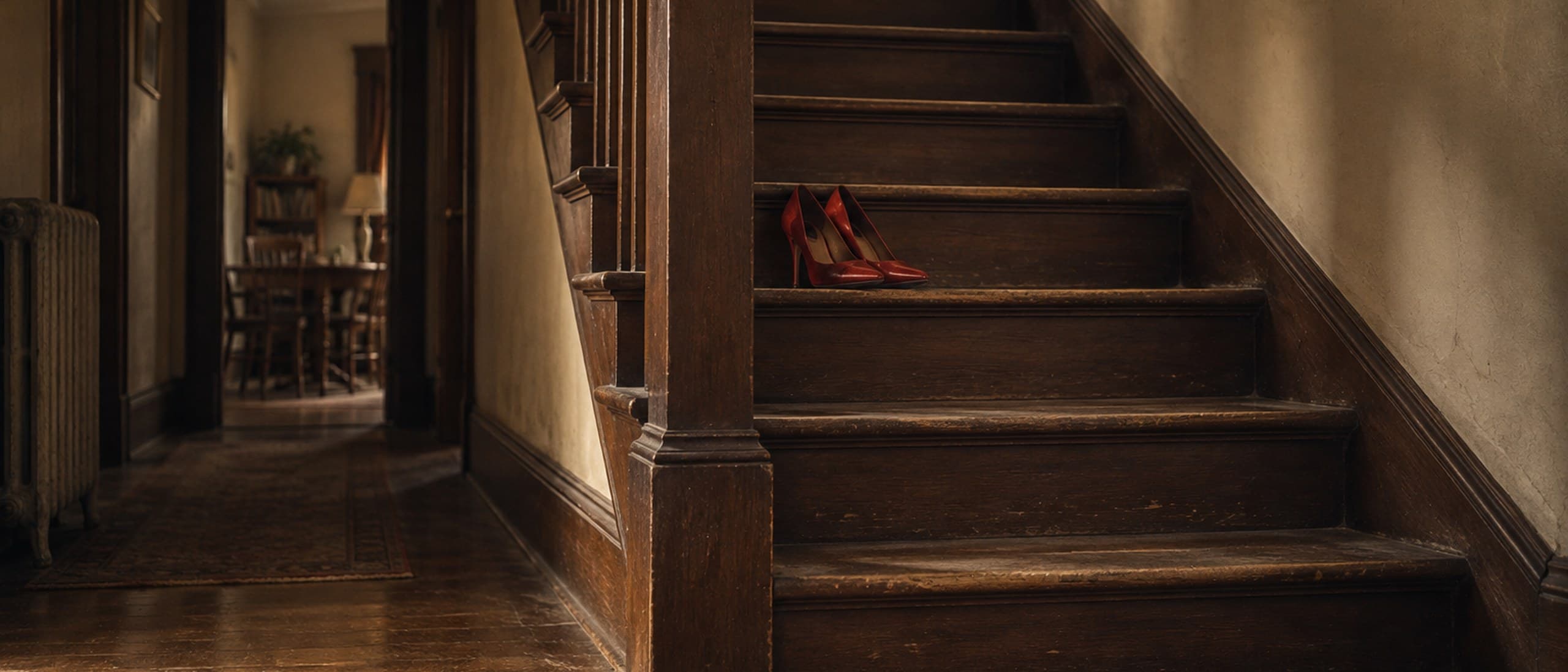
Ethelle Shatz has told the same story for more than seventy years, and nobody ever photographed it. Before she left Brooklyn for graduate school in Cleveland, her mother warned her that red shoes were "only for fast girls," so the first thing she did in the new city was walk into a shoe store and buy a pair. Then she came "clomping down the stairs" of the Roosevelt student co-op in those high heels, and a young architecture student standing at the bottom looked up and, in her telling, liked what he saw. That student was Burt, her husband, who now lives with dementia.
Love, Rendered, a 37 minute documentary short directed by Liz Garbus, is the story of rebuilding that one staircase with generative AI so Burt could see it again. It was made by Primordial Soup, Darren Aronofsky's AI studio, with Google DeepMind and Story Syndicate, the company Garbus runs with Dan Cogan, and it screened among the Telluride shorts before going up free on the Primordial Soup YouTube channel on Tuesday 8 September. Google co-made the film and is promoting it, and that should sit in the front of your mind while watching. It is also the most honest film an AI company has put its name to this year, and nearly all of that honesty lives in the parts the marketing leaves out.
The full 37 minute film is free to watch on the Primordial Soup YouTube channel: https://www.youtube.com/watch?v=TYlsVEtKe-8
The marketing says memory, and the film does not
Google's making-of post, written by DeepMind tech lead Michael Chang and published the day after release, runs under the title "Recovering fading memories with Google AI." It says the couple told the team the finished scene "felt authentic," and it signs off by pointing readers to the Gemini app so they can restore their own family photos. The film itself never claims that anything was recovered. Shown an early generated still of the staircase, Burt calls it "very off putting" and "fancier than I ever was exposed to," and when he is asked whether it brings anything back, he is plain about it: "No memory. Not at all."
At the final screening he smiles, stays awake and, asked whether the scene reminded him of Cleveland, says "I never have never forgotten it," a sentence that can carry almost any meaning you bring to it. Afterward one of his grandchildren worries out loud that he will not remember the day, and a relative, Chloe, answers: "But it meant something today."
That exchange is the real thesis of the film, and it is a smaller and better claim than the blog's. Nobody measures recall, no clinician on screen claims a therapeutic effect, and the crew goes out of its way to lower the bar: "We don't want him or the family to feel that there's a bar that we're asking him to reach." What the film shows is one good afternoon for a man in his nineties and the people who love him, which is worth a film on its own terms, and which is not the same thing as recovering a memory.
Ethelle is the art director
The part creators should study sits in the middle third. The team works from three exterior photographs of the co-op, restored black and white pictures of the couple, and prompts typed in front of the family ("Make the room darker. Move the columns."), while someone on the crew admits that "we are probably the first people ever trying this." Then Ethelle starts giving notes, and the film turns into something closer to a production meeting than a tech demo.
She does not remember the banisters being that decorative. There was no window on the staircase, and the arch should not be there either. The red is closer now, but the heel has to be thinner, "like a spike heel almost." Round after round the image gets corrected by the only living witness to the moment, until she looks at a frame and says, "It looks pretty much like it was, my dear." Google's post calls her a co-creator, and for once the vendor language undersells it, because she is doing the work a production designer and a script supervisor would normally split between them.
She also delivers the line every maker of this kind of film should pin above the desk: "You have to be so careful to tell the truth. And then if you're imagining it, you don't know if it's the truth."
The film keeps its seams showing
Documentary makers have more to lose from generated imagery than anyone, and the film says so in its own voice. "This is an existential issue," one of the filmmakers says early on. "People place documentary on a certain kind of pedestal and it's based on trust." Another voice from the production side admits, "I actually don't really like looking at AI generated imagery of humans. It makes me a little uncomfortable." The stated method is "to reveal the seams of the process in the content itself," and the edit follows through on it. The disclosure to the family before the first screening ("It is not an exact replica"), the rejected stills, and the moment the family notices the model has given Burt "a cleft chin" all stay in the cut.
The most revealing technical moment is about performance rather than pixels. The team records Burt and Ethelle today and maps their present expressions onto younger likenesses; Google's post credits its performance capture models with carrying "the specific tilt of Burt's head" and "a brief hesitation in his speech pattern." Watching one result, a team member notices that what reads as effort on Burt's face now reads as nervous love on the young one: "when you stick it on the young face, it becomes a different emotion." That is the sharpest observation in the film about what these tools actually do, since they do not carry a feeling across so much as reinterpret it, and someone still has to decide whether the new feeling is true to the story.
- Date: Tue 20 May 2025. What happened: Google DeepMind and Primordial Soup announce a partnership to make three short films with DeepMind models
- Date: Fri 13 Jun 2025. What happened: The first of the three, Ancestra, directed by Eliza McNitt, premieres at Tribeca
- Date: Sat 16 May 2026. What happened: At Cannes, Aronofsky tells Deadline the films are "purely additive"; Love, Rendered is in post-production
- Date: Thu 3 Sep 2026. What happened: Telluride announces its lineup, with Love, Rendered among the main-slate shorts
- Date: Fri 4 Sep 2026. What happened: Telluride opens and Primordial Soup posts the official trailer
- Date: Tue 8 Sep 2026. What happened: The full 37 minute film goes up free on the Primordial Soup YouTube channel
- Date: Wed 9 Sep 2026. What happened: Google publishes the making-of post by DeepMind tech lead Michael Chang
- Date: Mon 21 Sep 2026. What happened: A care-home operator where part of the film was shot re-uploads the trailer
What this means for anyone making memory work
In practice, for anyone making family history, memorial or reconstruction films this year, Love, Rendered hands you a working method in plain sight. Disclose on screen, both before the AI sequence and inside it. Keep a living witness in the correction loop and film the corrections, because the corrections are your evidence. Leave the failed frames in the cut. Let the AI scene sit inside observational footage instead of replacing it; here exactly one moment, the first meeting, is generated, and the other thirty-odd minutes are ordinary, patient documentary.
Aronofsky made the commercial case at Cannes in May, telling Deadline that none of the films Primordial Soup originates "would exist without this technology" and calling them "purely additive." Love, Rendered is the strongest evidence for that claim so far, because the scene it adds is one no camera recorded and no budget could have restaged with the two people who lived it. The film earns that argument by refusing to oversell its own trick, which is more than its launch post managed.
Two things stay open. Google has not said which models made the final scene (Veo is named once, for a personal test Chang ran on photos of his own parents), so any "made with Veo" credit is guesswork. And Burt's own capacity to agree to his younger likeness being generated is never addressed on screen; the family takes part openly and warmly, but the question belongs to him, and the film leaves it with the audience.
Sources and reporting notes
Quotes and scene details are from the full uploaded English caption track of Love, Rendered (YouTube TYlsVEtKe-8, Primordial Soup channel, 37:03, published 8 September 2026); we read the captions in full but did not watch the picture, so speakers the captions do not name are not named here, including the "existential issue" and "uncomfortable" lines. Credits are from the Primordial Soup description and Google's post. Technical method and the "felt authentic" and "co-creator" language are from Michael Chang's post on the Google blog, 9 September 2026, a vendor account. The partnership is from Google's announcement of 20 May 2025; Aronofsky's quotes are from Deadline, 16 May 2026; the Telluride selection is from the festival's lineup release of 3 September 2026. The trailer re-upload by LCB Senior Living is credited to the location partner that posted it, not to the filmmakers. No press stills exist, so no frame of the film and no likeness of the Shatz family is used with this article.