The label that makes you call your own work a lie just lost in federal court
A federal judge in Montana enjoined SB 25 against Dan Bartel and his PAC only, finding the law viewpoint-based and its safe-harbor label a compelled self-falsification that Citizens United does not support. Vagueness was not decided, the private right of action was not enjoined, and every other advertiser in Montana is still inside the statute.
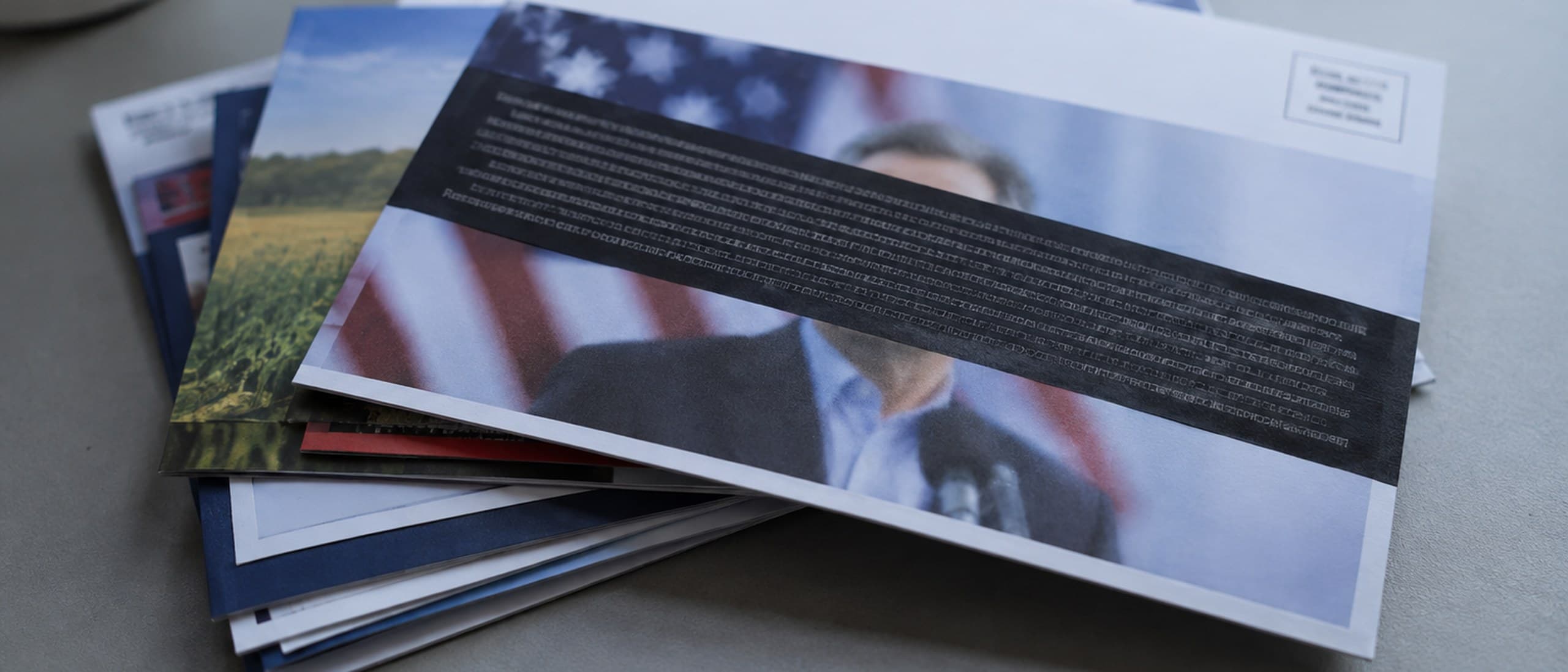
The mailers that started this were not subtle. Dan Bartel's committee, Accountability in State Government, sends flyers about how Montana legislators vote, and three of them took real photographs of real candidates and added things: preferred-pronoun pins, pride flags, and in one case a gas-pump nozzle spraying ten-dollar bills with the price reading "Arm" and "Leg." Two of the targeted candidates and one other legislator complained to Montana's Commissioner of Political Practices, and one of them, Republican Rep. Jennifer Carlson, said in her complaint that the flyer was made "with the intent to injure the reputation of the candidate or otherwise deceive a voter." That is almost a direct quote of the statute she was invoking.
On September 16, at 4:53pm, Senior US District Judge Susan Watters signed a 40-page order telling Montana's attorney general, the Lewis and Clark County attorney and the commissioner that they may not review, investigate, prosecute, adjudicate or enforce that statute against Bartel or his committee. The law is Senate Bill 25, codified at Montana Code Annotated 13-35-801 to 804, and the court found the plaintiffs likely to win a facial First Amendment challenge to it.
Most coverage read this as a deepfake law going down. The more useful reading, for anyone who makes synthetic footage for a living, is narrower and sharper: the specific thing that failed strict scrutiny was a disclosure that forces a maker to brand their own work untruthful.
What Montana actually wrote
SB 25 is not a ban on AI in political ads and not a general labeling mandate. Inside a 60-day window before voting starts, it prohibits paying for or sponsoring an election communication you knew or should have known is a deepfake of a candidate or party, where "deepfake" means synthetic or AI-generated media depicting them with intent to injure their reputation or otherwise deceive a voter.
Then comes the safe harbor, and the safe harbor is the part worth reading twice. The ad survives if it carries this exact sentence: "This [image/audio/video/multimedia] has been significantly edited by artificial intelligence and depicts speech or conduct that falsely appears to be authentic or truthful." The statute specifies the delivery, too. Twelve-point bold minimum in print, at least four percent of vertical picture height on video, at least eight seconds of audio.
Enforcement runs on two tracks. An aggrieved candidate or party can sue for an injunction, actual damages and up to $10,000 in punitive damages on an expedited docket. Separately, complaints reach the commissioner, where a first sufficiency finding brings civil penalties, a second a misdemeanor referral and a third a felony referral.
The court's problem was who the law protects
Watters found the Act content-based and viewpoint-based on its face. Liability attaches to synthetic media made to injure a candidate and not to identically synthetic media made to flatter one, so the Act "treats identically deceptive media differently based solely on whether its message is weaponized to damage or deployed to elevate a candidate." She called that presumptively unconstitutional, reaching for the trademark cases, Matal v Tam and Iancu v Brunetti, rather than the election cases.
Montana conceded the compelling interest. Election integrity was never in doubt. Narrow tailoring is where the state lost, because it never explained why existing tort law, election-interference offenses, voter education and plain counterspeech were inadequate, and a state that restricts speech first gets "minimal deference" for that choice. Two earlier rulings did the work here, both cited in the order: Kohls v Bonta, which permanently enjoined California's AB 2839 in August 2025 and is now on appeal in the Ninth Circuit, and Babylon Bee v Lopez, which killed Hawaii's Act 191 statewide in January 2026. This Montana order is the narrowest of the three, not the first of anything.
The disclosure holding is the part that travels
Montana's best argument was that the safe harbor rescued the law, because Citizens United upheld a compelled disclaimer on political advertising. Watters drew a line through that. Citizens United made a speaker say who paid for the ad. SB 25 makes a speaker "declare their own content inaccurate or untruthful," which the order calls "an outright alteration of the speech itself" and a risk of drowning out the message entirely.
What this means for AI creators: a mandated line that characterizes your own work as false, in a prescribed size and duration, is now the weakest form of disclosure in this circuit, and a neutral "this was AI-generated" line is not what lost here. Those are different asks, and the difference is doing real legal work. If you are building a compliance habit around synthetic performers and voices, the label that simply records provenance, meaning where a frame came from and how it was made, is on much firmer ground than any label that requires you to editorialize against your own footage.
Two live examples of the firmer kind. New York's synthetic performers disclosure law has been in effect since June 9, 2026, requiring a conspicuous disclosure when an ad shown to a New York consumer features an AI-generated human likeness, at $1,000 for a first violation and $5,000 after. California's SB 1050 was signed on September 16, the same day as this order, and asks for wording substantially similar to "this performance features a synthetic performer" in ads that prominently feature one, enforced through false-advertising law. It is not operative until January 1, 2027, so despite a lot of coverage suggesting otherwise, nothing is being required in California yet.
Almost nobody in Montana is actually protected
Bartel asked for the Act to be unenforceable statewide. He did not get it, and citing Trump v CASA, the court held instead that a district court has no authority to issue a universal injunction, that neither a state law's status nor a facial overbreadth claim creates an exception, and limited relief to the two plaintiffs in front of it.
The order therefore says two things that sit oddly together. Quoting the Ninth Circuit's Imperial Sovereign Court of Montana v Knudsen, it records that a content-based restriction failing strict scrutiny is "facially invalid and cannot be enforced against anyone." Twenty pages later, the only people it cannot be enforced against are Dan Bartel and his committee. Every other political advertiser in Montana is still inside a statute a federal judge has called presumptively unconstitutional, and the private right of action at 13-35-803 is not enjoined at all, because the candidates who might use it were never defendants here.
Timeline
- Date: 2025 session. Event: Montana passes SB 25, signed by Gov. Greg Gianforte, codified at 13-35-801 to 804
- Date: Spring 2026. Event: ASG PAC mails AI-altered flyers before the June primary; three complaints filed with the Commissioner
- Date: 6 May 2026. Event: Complaint filed in the District of Montana, 6:26-cv-00038
- Date: 17 Jul 2026. Event: Motion for a preliminary injunction filed
- Date: 20 Aug 2026. Event: Commissioner's declaration filed; per Reason, the three complaints are dismissed as satire or parody
- Date: 21 Aug 2026. Event: Injunction hearing, ruling requested by 25 Sep
- Date: 16 Sep 2026. Event: Order granting the preliminary injunction entered at 4:53pm, 40 pages
- Date: 16 Sep 2026. Event: California signs SB 1050, synthetic performer ad disclosure, operative 1 Jan 2027
- Date: 17-18 Sep 2026. Event: Reuters, KPAX, Yellowstone Public Radio, Daily Montanan, Montana Free Press and Reason report the ruling
- Date: 3 Nov 2026. Event: General election
What is still open
The court did not reach vagueness. Footnote 1 says the content and viewpoint holdings were enough, so the plaintiffs' Fourteenth Amendment arguments, including the fact that the statute exempts satire and parody without ever defining either, remain undecided in this case. That exemption is not academic: the commissioner filed a declaration on August 20, the day before the injunction hearing, saying the Bartel complaints should be dismissed as satire or parody with formal dismissal "forthcoming." Reason reports the complaints were dismissed that day. The court noted no evidence of dismissal was ever filed, which is part of why it found the dispute still live.
Whether Montana appeals is unknown. The public docket's last entry as of September 21 is the order itself, and the attorney general's office told Yellowstone Public Radio it is reviewing the ruling to determine next steps. Public Citizen counted 30 states with election-deepfake laws in May, and three of them have now been through a federal court. Two of them came out struck down, and this one came out struck down for two people only.