Netflix's 300 AI titles come with a map, and a human at every exit
At Creative Asia in Busan, Netflix's Sung Q Lee, Weta FX CTO Kimball Thurston and director Kang Yun-sung described the same loop: AI widens the options and a person picks. The 300-title figure repeats Netflix's July letter with no list, and Kang's 40% saving is a fundraising estimate for a film not yet shot.
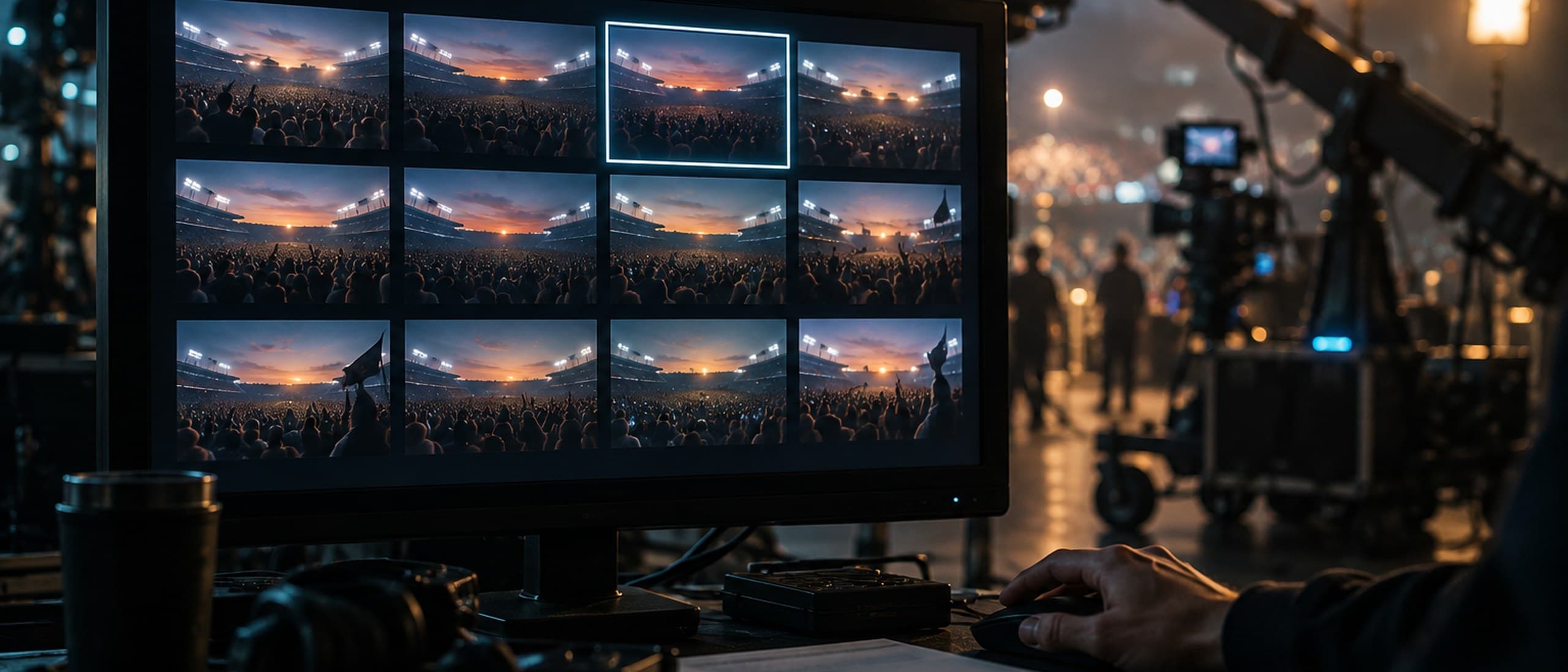
On Saturday in Busan, Netflix's Sung Q Lee played a room of young filmmakers a clip of crowd scenes from Glory, a Netflix India title, built with a mix of generative tools and conventional VFX. Without that mix, he told them, those scenes would have been cut for budget and schedule, according to Variety's report of the session. It was a small moment in a long panel, and it said more than the headline number that followed it around the trades all weekend.
That number is roughly 300, the count of Netflix titles Lee said have used AI in some form. It traveled fast as if it were news, but Netflix had already put the same figure in its second-quarter letter to shareholders on 16 July: "In 2026, GenAI workflows have been used in roughly 300 of our titles, with the largest concentration of work in post-production." What Busan added was something more useful to anyone making work with these tools: a production executive, the chief technology officer of Wētā FX and a working Korean director describing where the tools actually sit, and all three putting a person at the point where a choice gets made.
Where the 300 actually sit
The panel was part of Creative Asia, the program Netflix runs with the Busan International Film Festival, held at Dongseo University's Centum Campus and co-hosted with the Motion Picture Association. Netflix says more than 400 emerging filmmakers attended. Lee, Netflix's senior director of production for Asia Pacific, shared the stage with Kimball Thurston of Wētā FX and the director Kang Yun-sung, with the critic Yun Sung-eun moderating.
Lee's list of where generative tools land in a Netflix production was specific: previsualization, production design, set-dressing concepts worked up in advance, editorial and VFX. The same list appears in THR, Variety and Deadline. He also played a reel from Eyeline, Netflix's in-house VFX studio, on what he called hybrid production, live action and VFX combined with generative tools. And he was at pains to sound unhurried. "We have strict guidelines within the company," he said, as Deadline reported it, adding that Netflix is not trying to be the fastest by using AI. Variety has him saying a human touch is absolutely essential, and closing on the line that, in the end, it is humans who will write.
None of this tells you what counts as one of the 300. Netflix has not said how much AI a title needs to make the count, the July letter scoped it to 2026 while the Busan version had no time frame, and no list exists. The letter named three examples: Glory from India, Brasil 70: A Saga do Tri from Brazil and The American Experiment from the US. On the earnings call that day, co-CEO Ted Sarandos said The American Experiment carried 17 minutes of AI-enhanced footage, "produced twice as fast and at half the cost of previous options", as IndieWire reported.
Wētā FX's CTO wants better controls
Thurston was the most precise speaker on stage, and his precision is the useful part. Wētā uses AI "at a measured pace" for image clean-up and generating crowd motion, he said, "not necessarily for generating images", per Deadline. He described the deep learning denoiser that won the company a Sci-Tech Award as assistive AI: "It touches pixels, but it only fixes them," he said in Variety's account.
He was just as specific about what the tools still cannot do. Color is one gap: "You get Netflix red, but not Coca-Cola," he said, by Variety's transcription, meaning the models cannot yet hold an exact brand or production color across shots. The interface is the other, since a text prompt, in Deadline's version of his remarks, is not the best way for a visual artist to work. Variety also reports that Wētā is building an open-source tool through the Academy Software Foundation to track where and how AI was used on a shot, designed to link with C2PA, the content-credentials standard that attaches a tamper-evident record of how an image was made.
Kang's 40% is a pitch, not a receipt
Kang is best known for The Outlaws (2017), and he is also one of the few directors on any festival stage this year who has put an AI feature in cinemas. Run to the West, which he co-directed with AI filmmaker Kwon Han-seul, opened in Korea on 15 October 2025 as a CGV exclusive, took 22,447 admissions by 19 October according to KOBIS figures reported by HanCinema, and has grossed about $97,000 worldwide on Box Office Mojo.
The figure that made the headlines came from an audience question about his next project, The Gulf of Aden, a naval piracy thriller that Deadline describes as an upcoming Netflix film. Kang said his team made a test clip entirely in Kling earlier this year, at reduced quality, and that the calculation they did for financing put AI's saving at around 40% of the budget. THR and Variety both tie the figure to raising money for the film. Netflix's own recap hardens it into the past tense, saying AI cut overall costs by 30 to 40%, but the film has not been shot, and no final budget or breakdown exists.
The detail worth keeping is where Kang said the saving comes from: simpler shoots and a shorter schedule, not only cheaper effects. "What has been buried due to budgetary issues was able to be put back on the table," he said, in THR's translation. He was also the panel's most candid skeptic. AI cannot replace actors, he said, describing a mechanical coldness in synthetic performance, and while the images keep getting better, he told Variety the emotional delivery has actually gotten worse, because fewer people are in the discussion.
Down the hall, Eyeline drew the same gate
Eyeline's James Rustad, the studio's global head of GenFX, was not on Lee's panel, despite the way some coverage bundled the weekend together. He spoke at a separate InnoAsia session at the Asian Contents & Film Market, reported only by Variety. His example was Brasil 70, which he said ran to more than 1,300 VFX shots, over 800 of them on the pitch, with Eyeline working alongside 45 artists on a hybrid approach.
Rustad described a four-stage workflow for a generative shot: setup, narrative, look and delivery. The narrative stage is where artists choose which outputs become shots, and his line, in Variety's translation, was that artists' judgments are also important. It is the same loop Lee and Thurston described from the other side of the market: widen the options, then let a person pick.
What this means for anyone making AI work
In practice, for anyone making work this week, Netflix has just described your workflow as studio standard. Previs, set-dressing concepts, crowds, clean-up and iteration with a human selection step is what independent AI filmmakers have been running since the tools arrived, and Netflix now says it uses the same steps across hundreds of titles. That is a credential for every creator pitching AI-assisted work to a producer who still thinks of it as a stunt.
- Kang's route is a template for the pitch, not just the production: a short AI test clip to sell the scale, and a budget model that shows where the schedule shrinks.
- The gaps Thurston named, exact color control and interfaces that are not prompt boxes, are where a working studio still needs help, and where tool builders and technical artists can find work.
- Provenance is coming for commissioned work. If Wētā is building a C2PA-linked log of AI use per shot, keep your own record of which tools touched which shots before a buyer asks for one.
What Netflix still has not said is which 300 titles, or how a viewer would know. Nobody on the panel addressed disclosure, and until there is a list, the count tells us how widely the tools are used without telling audiences where to look.
Timeline
- Date: Wed 15 Oct 2025. What happened: Run to the West opens in Korea, CGV exclusive; 22,447 admissions by 19 Oct, about $97K worldwide; Source: KOFIC, HanCinema (KOBIS), Box Office Mojo
- Date: Thu 16 Jul 2026. What happened: Netflix Q2 letter: GenAI used in roughly 300 titles in 2026; Sarandos cites 17 minutes in The American Experiment; Source: Netflix Q2 2026 letter, IndieWire
- Date: Wed 16 Sep 2026. What happened: Netflix and BIFF announce the Creative Asia AI panel; Source: Variety
- Date: Sat 10 Oct 2026. What happened: Creative Asia panel with Lee, Thurston and Kang; Netflix posts its recap; Source: Netflix, Variety, Deadline
- Date: Sat 10 Oct 2026. What happened: Variety reports Rustad's separate InnoAsia session at ACFM (session date not stated); Source: Variety
- Date: Sun 11 Oct 2026. What happened: THR report on the 300 figure; Source: THR
Sources and what is unconfirmed: Netflix Q2 2026 shareholder letter (16 Jul); Netflix's Creative Asia recap (10 Oct); The Hollywood Reporter (11 Oct); Variety's panel and Rustad reports (10 Oct); Deadline (10 Oct); IndieWire (16 Jul); HanCinema, KOFIC and Box Office Mojo for Run to the West. No recording of the panel was available to us, so every quote is a trade or Netflix transcription, several translated from Korean. THR and Deadline credit Lee with a "human touch" line that Netflix's recap gives to Thurston. What counts as one of the 300 titles is undefined, Kang's 40% is a financing projection for an unmade film, The Gulf of Aden as a Netflix title rests on Deadline alone, and Rustad's remarks come from a single Variety report. We did not contact Netflix, Wētā FX or Kang for this draft.
Your Voice
The Outlaws director says AI could cut 30-40% off a feature budget. He also says it's gotten worse at moving audiences. I thought we’d have a way cooler dystopia
the budget savings have a line item. it just never appears in the press release.
AI is already being used across 300 Netflix titles. Ad business targeting $3B in 2026. Netflix doesn't need more viewers to become more profitable.
Quoted from public posts on X and credited by handle. If one of these is yours and you want it removed, message @the__generated on X and it comes down.
Got something to say? Tag @the__generated on X