Schrader couldn't cast his noir. Now he says AI will play the leads.
Paul Schrader says his shelved noir will be made with AI-generated performers instead of a cast. It is an intention, not a production: no financing, no start date, no named collaborators. What it changes for creators is which scripts in the drawer can now be made without anyone's permission.
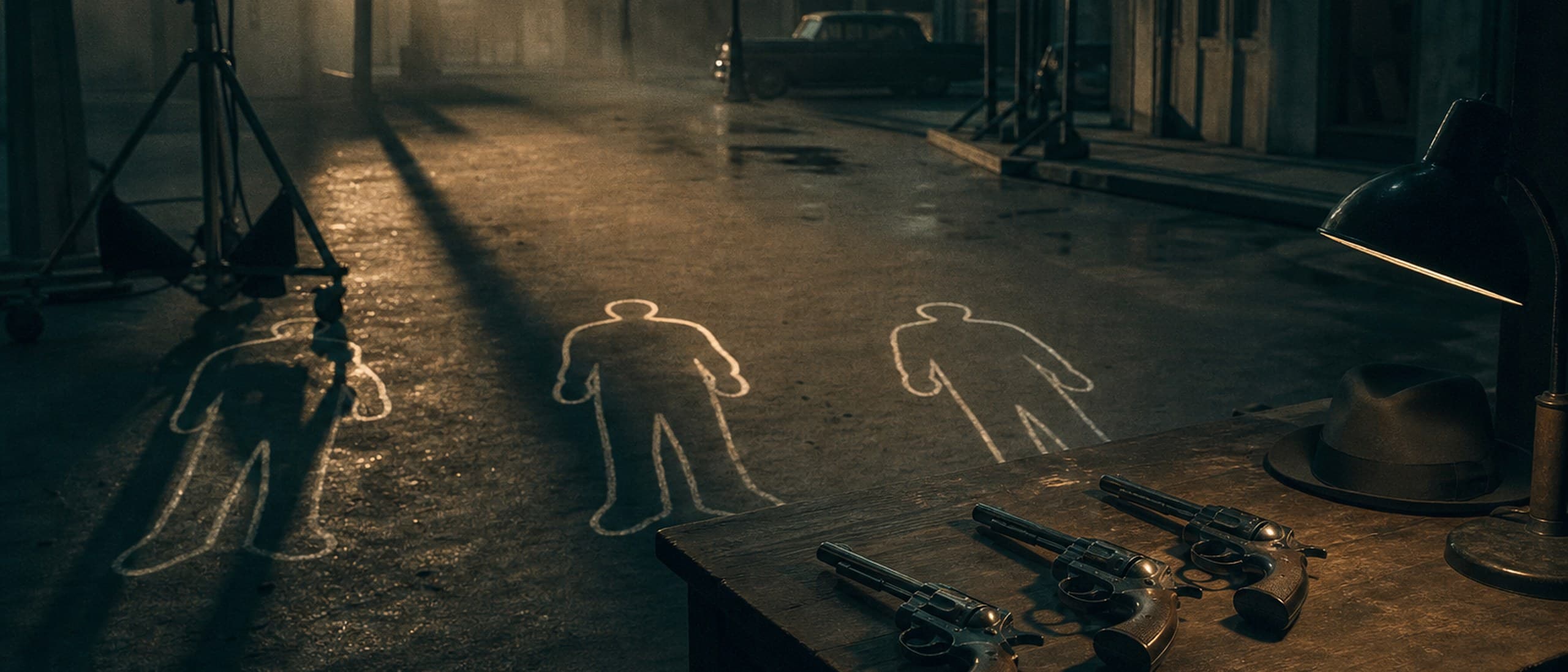
In Venice last week, the writer of Taxi Driver told a reporter that one of his next films will have no actors in it. "I'm doing one film now which is all AI," Paul Schrader told The Hollywood Reporter on 3 September, "and another which is probably 15 minutes of AI." The all-AI one is a noir about three brothers, a corrupt cop, a drug dealer and a serial killer, built around what he calls AI-generated human prototypes rather than name actors. Asked about the people whose work that displaces, he did not hedge: "Those jobs are gone, babe. You can scream 'Stop AI' all you want, but you can't stop it."
The quote has been traveling this week as a morality tale about machines eating cinema. The reason it matters to anyone making work is duller and more useful than that. Schrader is not choosing synthetic performers over human ones on principle; he is choosing a finished film over a script that sat in a drawer, and the thing standing between the two was never money.
Why the film actually stalled
The project used to be called Three Guns At Dawn. Schrader wrote it during the 2023 strikes, three Black brothers in South Central Los Angeles, with Antoine Fuqua attached as producer and the script sold to Netflix. Fuqua wanted Schrader to direct, Schrader floated co-directing with a Black filmmaker, and then casting killed it. His account, given to The Playlist: "We sent it out to actors, and no Black actors wanted to play in a movie where there are no good Black people. And it sort of died. But then AI came along, and I didn't need Black actors."
That reframes the story. A script with a producer and a streamer behind it is not an unfinanceable film; it is a film that ran into a representational objection from the people it needed, and the objection was about the material. What AI offered Schrader was not a cheaper crew, it was a route around consent. Fuqua is out, and the reconfigured version does not appear to be carrying the old title.
It is also, so far, only an intention. There is no announced financing for the AI version, no start date, no toolchain and no named collaborators, and no actor who declined has given their own account. Filmofilia reported on 6 September that the production technology, the current financing and the actors' side all remain undisclosed, and Netflix's rights position after the reconfiguration has not been reported anywhere. Schrader says he will make this film. He has not started it, and that gap is where most of the coverage this week has quietly gone wrong.
The rules that decide where this is legal
The industry spent 2026 writing rules for exactly this scenario, and those rules describe a map with one large unguarded edge.
Under the 2026 TV/Theatrical Agreement, a signatory producer cannot drop a synthetic performer into a project without first giving SAG-AFTRA notice and bargaining over it, on a schedule enforceable by arbitration. Producers also accepted a test that reads like a warning label: they do not intend to use a synthetic in a human role a human would otherwise play unless the synthetic delivers significant additional value beyond what a digital replica of a real performer could do. A synthetic performer, in the contract's language, is a wholly generated asset that is not recognizable as any real person and is not voiced by an actor. Let a real performer's principal facial feature through and it becomes a recognizable synthetic performer, which needs that individual's consent. The per-role levy on synthetics that the press nicknamed the Tilly Tax was rejected by the AMPTP in May, so enforcement runs through notice, bargaining and arbitration rather than a fee.
None of that binds a production which is not a signatory, and that is our reading rather than a reported fact. An independent film financed outside the studio system, made with generated performers and no union cast, sits outside the notice duty, outside the bargaining schedule and outside the arbitration route. It is simultaneously the loophole a studio would be crucified for using and the open door independent filmmakers have been asking for since the first strike. Schrader, whether or not he has thought it through, is standing in the doorway. Whether SAG-AFTRA has been notified about his project is unreported.
What creators should take from this
The pitch that AI collapses budgets is real, and it is also being sold hard by people with something to sell. Roger Avary, who has an Oscar for Pulp Fiction, told the trade press in February that "just put AI in front of it, and all of the sudden, you're in production on three features," and claimed visual effects at $5,000 a minute against a historic $1 million. That ratio is a promoter's number, not an audited one. Doug Liman's Bitcoin: Killing Satoshi has been framed as a $300 million film brought down to $70 million by AI backdrops, and Film Stories showed the comparison was inflated. The 2026 slate of finished AI features is more sobering than either claim: Cully Hill Boys made for around $2 million and released free online, Punky Duck pulled by Amazon after two days of backlash, Critterz reportedly under $30 million.
In the same week Schrader made his announcement, the Creative Arts Emmys gave Outstanding Special Visual Effects in a Season or a Movie to Stranger Things season five and the single-episode award to Spider-Noir, each with a dozen credited humans across Wētā FX, ILM, Cinesite, Barnstorm, Eyeline and CoSA. The expensive human craft layer is still what wins on the night, which tells you where taste is currently priced and where it is not.
So the opportunity here is not firing the cast, it is inventory. Most working writers and directors have a drawer of work that died for reasons which had nothing to do with quality, and the whole apparatus of gatekeeping ran on the fact that a script needed dozens of consenting professionals before it could exist at all. That gate is now optional for some kinds of film, which makes the drawer the most valuable asset in independent production and hands the decision about what gets made to whoever owns it. That is a real transfer of power toward writers and directors, and it arrives with no filter attached, which is why the first wave will contain both the films the system was wrong to block and the films it was right to.
The honest caveat
Schrader is not a neutral narrator. His Venice premiere for The Basics Of Philosophy came with reviews that put his own admitted misconduct in the frame, and his account of why the film died is an account in which no actor and no agent has spoken. He names nobody, and he gives no number of approaches. It is entirely possible that a script Black actors declined had a problem its author is not the best judge of, and a technology that removes the need to persuade anyone also removes the last person who could have told him so.
The tool that lets you make the film nobody would greenlight is the same tool that lets you make the film nobody should have, and both are now shipping from the same drawer using the same software. What is still unresolved is narrow and checkable: who finances the AI version, what Netflix retains after the reconfiguration, whether SAG-AFTRA has had notice, and whether any of the actors who said no will say why.
Sources: The Hollywood Reporter, 3 Sep 2026; The Playlist, 3-4 Sep 2026; The Verge, 6 Sep 2026; Filmofilia, 6 Sep 2026; SAG-AFTRA 2026 TV/Theatrical AI provisions; TheWrap, 22 May 2026; Television Academy 2026 winners; Film Stories, 16 Apr 2026; ScreenWeaver, 24 Aug 2026.