WPP's big AI bet is a building with a freezer in it
Devon's Point is a 34,000 square foot production house with a 16 by 14 meter LED wall, creator studios and product freezers, with AI as the wiring rather than the product. WPP names no cities, dates or budget for its global rollout, and it arrives as the company cuts about 11,000 jobs. For AI creators the opening is hybrid work: environments for the wall and versions after the shoot.
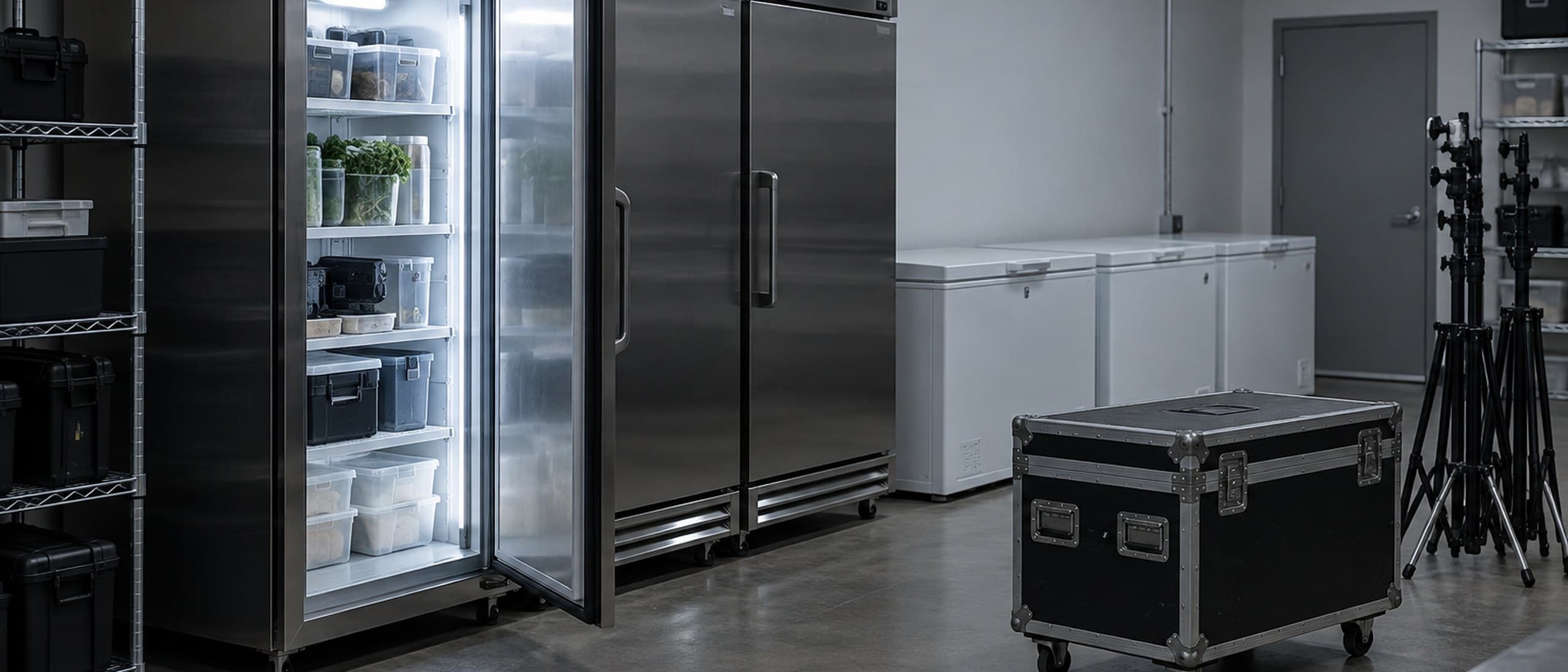
Somewhere on the list of things WPP has put inside its new east London production hub, between the four grade suites and the props store, sits a line about climate-controlled storage for client products, industrial fridges and freezers included. It is the most honest detail in the announcement. Devon's Point, which opened on Wednesday 23 September, is being sold as an AI-powered production hub. What WPP actually describes is a very well equipped physical studio, built for shooting cans, cars and cereal at volume, with AI running through the walls rather than standing on the stage.
The building covers 34,000 square feet over several industrial floors. Its main stage is 7,000 square feet, with an LED wall 16 meters wide and 14 meters tall that WPP calls one of the largest LED screen environments in the UK. Around it are creator and live-streaming studios, a commercial kitchen studio, modular stages that subdivide, an infinity cove with motion tracking, a set build workshop and an art department. It is run by WPP Production, the unit of nearly 10,000 people that replaced the Hogarth brand in February, and members of HEX, WPP's creative technology studio, will be based there. WPP says it is the first step in a global rollout across every continent where WPP Production operates. No cities, dates or budget have been disclosed, by WPP or by anyone reporting on it.
Count the AI in the spec sheet
WPP's release lists eight facility features. Exactly one of them mentions AI: a server room connected through WPP Open, the company's agentic marketing platform, to what the release calls AI-enabled production workflows. The word generative appears twice in roughly 1,075 words, once to describe what HEX does and once in a quote from WPP Production chief executive Richard Glasson, who describes a place where "virtual production, generative workflows and physical creation coexist seamlessly." No model, vendor, tool or workflow is named anywhere, not in the release, not in the chief executive's interview with Reuters, and not in the trade coverage that followed.
The one worked example comes from that Reuters interview with Cindy Rose, WPP's chief executive: putting a real Ford Capri into a virtual Paris street. That is a textbook LED volume shot, the kind of in-camera virtual production that has existed since well before anyone could type a prompt into a video model. Nothing says whether the Paris street was generated, built in a game engine or photographed as a plate, so the honest reading is that WPP has built a first-class virtual production stage and is describing it in the language its clients currently want to hear.
The novelty claim needs the same care. WPP calls Devon's Point the first facility of its kind by a marketing services company in the UK, and the qualifier is doing real work. Its own Hogarth business announced LED volume stages for London, Sydney and New York in July 2022, and Publicis Production already runs a 3,000 square meter extended reality studio in Aubervilliers, outside Paris. At 14 meters, the height of the new wall is unusual for a UK volume, which makes "one of the largest" plausible; Garden Studios in London runs a wall 24 meters wide and 5 meters tall, so "largest" would not be.
Why a holding company is spending on bricks
Rose was candid with Reuters about what the building is for. Clients including Coca-Cola, Unilever and Ford want hyper-local, community-led content at scale, and they want it built so it can surface when people ask AI chatbots for recommendations. Then the commercial line: "It's about winning new business, because a lot of the pitches that we respond to these days are integrated mandates across creative, production, media and increasingly enterprise solutions."
Read that way, Devon's Point is a pitch asset as much as a studio. Ad Age reported on 11 September that WPP is set to win Coca-Cola's global media, data and technology review after Publicis dropped out, and a building that can shoot the product, cut the edit and push the variants into a media plan is exactly what an integrated mandate is meant to buy. It also arrives inside a harder story. WPP has cut about 11,000 jobs since the start of 2025, reported headcount of 97,388 at the end of June, and the Financial Times reported on 1 September that up to 1,000 more roles would go by year end. The company that is shrinking its payroll is expanding its floor space, and those two facts belong in the same paragraph.
- Date: Jul 2022. What happened: Hogarth adds LED volume stages, starting with Sydney, New York and London; Source: LBB Online
- Date: 2022. What happened: WPP Creative Technology Apprenticeship launches in London; Source: WPP
- Date: Thu 22 Jan 2026. What happened: WPP announces WPP Production and retires the Hogarth brand after 18 years; Source: WPP
- Date: Mon 23 Feb 2026. What happened: WPP Production takes effect, led by Richard Glasson; Source: WPP
- Date: Thu 4 Jun 2026. What happened: HEX launches with about 50 creative technologists; Source: WPP
- Date: Thu 6 Aug 2026. What happened: Interim results; shares rise 29% on the day; Source: Reuters
- Date: Tue 1 Sep 2026. What happened: Up to 1,000 more job cuts reported by year end; Source: Financial Times via Reuters
- Date: Fri 11 Sep 2026. What happened: WPP reported set to win the Coca-Cola global media review; Source: Ad Age
- Date: Tue 15 Sep 2026. What happened: IAB UK forecasts creator partnership ad revenue of £1.217 billion for 2026; Source: IAB UK
- Date: Tue 22 Sep 2026. What happened: Runway launches DIFFUSE, a hiring platform for AI-native creatives; Source: Runway
- Date: Wed 23 Sep 2026. What happened: Devon's Point opens in east London; Source: WPP; Reuters
The room is built, and nobody has said who fills it
The most interesting parts of the building are the ones aimed at people. The creator and live-streaming studios sit on site because brand money is moving toward creators: IAB UK's study of 15 September put UK advertiser spend on creator partnerships at £966 million in 2025 and forecasts £1.217 billion this year. The building also doubles as a training base for WPP's Creative Technology Apprenticeship, a nine-month paid scheme that has run in London since 2022 and, according to the HEX launch in June, aims to train at least 1,000 people by 2030.
That is a holding company saying, in bricks, that the talent to run this kind of pipeline does not yet exist in the numbers it needs. The day before Devon's Point opened, Runway launched DIFFUSE, a platform for hiring AI-native creatives, alongside its own research finding that 17% of more than 1,000 creative job postings it analyzed now ask for AI skills. One side of the market built the room and the other built the marketplace, in the same week.
Analysis: what this means for AI creators
In practice, for anyone making work this week, the useful reading is the opposite of the doom one. The biggest buyer of commercial production in the world has just confirmed that the job is still physical: a product on a stage, a car in front of a wall, a chef in a kitchen, a creator on a set. AI enters as the environment on the LED wall, the variant engine after the shoot and the plumbing that connects the edit to the media plan. That is our inference from what WPP chose to build and to say, since the company has named no tools.
It rewards a particular kind of creator. A director who can design a generated environment for a volume, light a real object to sit inside it and then turn one hero shot into fifty market versions without losing the idea is exactly the profile this building assumes. If you already work in hybrid, your reel should show the plate, the stage day and the finished spot side by side, because that is the workflow a facility like this is built to sell to clients. If you only work in pure prompt-to-video, the opening is in the environments and the versioning, and less in replacing the shoot.
What remains unresolved is the part that decides who gets paid. WPP has not said whether outside directors and AI-native studios can book the stage, whether the work will be staffed by apprentices and HEX technologists, which generative tools run on the server room's side of the wall, or what any of it costs a client. Until the second hub is named and the first outside production is credited from inside Devon's Point, the freezers remain the most concrete thing we know about it.
Sources and reporting notes
Facility specification, the Richard Glasson quote, the rollout statement and the IAB UK figure are from WPP's newsroom release of 23 September 2026, read in full. Cindy Rose's remarks, the Ford Capri example and the 29% share move are from Reuters (Paul Sandle), read in full via syndication; the chatbot line is Reuters' paraphrase, not a direct quote. WPP Production and HEX details are from WPP's releases of 22 January and 4 June 2026. Job figures are from Reuters, citing the Financial Times. The Coca-Cola review is from Ad Age, 11 September 2026. LED volume comparisons are from LBB Online (July 2022), Publicis Production and Garden Studios. DIFFUSE and the 17% figure are Runway's own. ADWEEK's preview was only partly read because of its paywall, so nothing here relies on it. Not disclosed and not stated: the exact address, the investment figure, headcount on site, the tools in use and the next cities. No reporter from this publication visited the site.