"AI should make no shots": Zack Snyder drew a line he cannot police
Zack Snyder says AI should make no shots, yet he keeps ChatGPT on his phone and admits he cannot tell whether a vendor's CG lamp was modeled or generated. The line he draws sits at the frame, and nothing in his pipeline lets him police it.
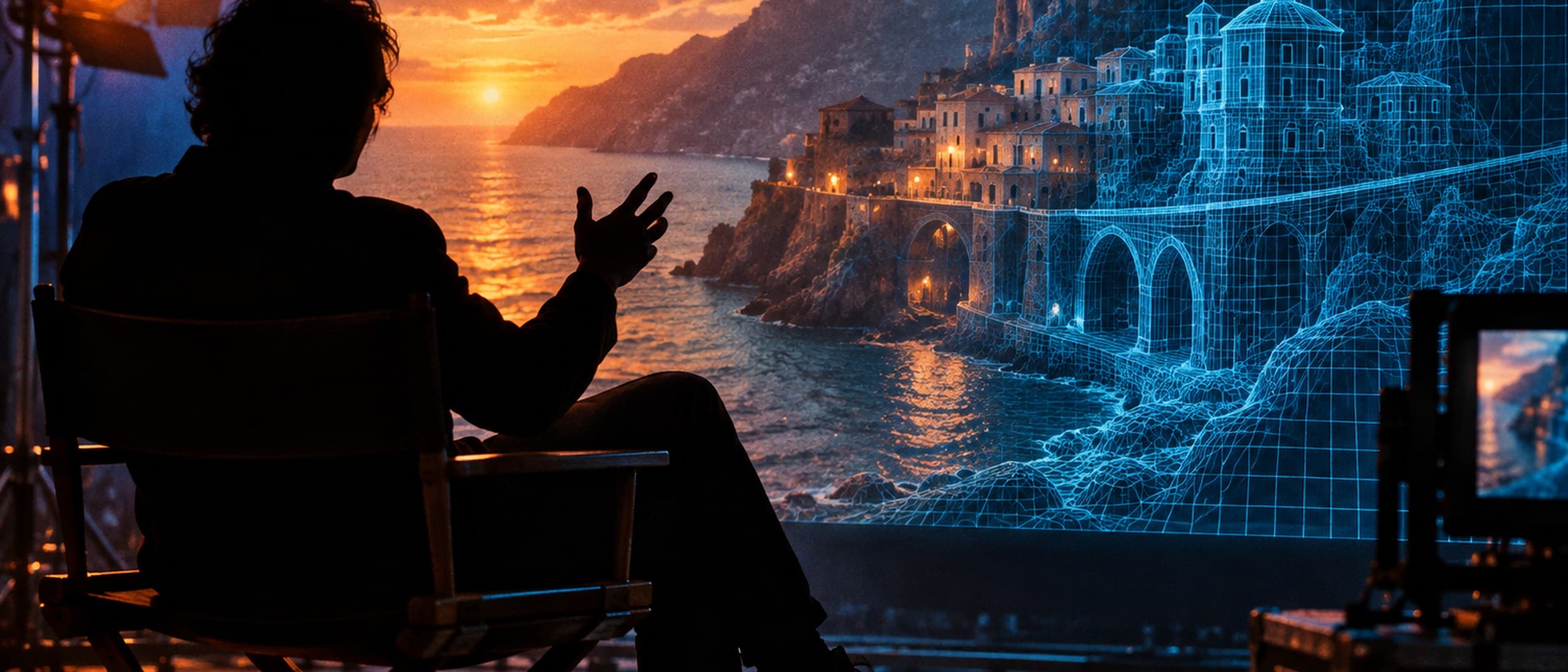
A director sits in a screening room and approves a lamp. It is a CG lamp, dropped into a shot by a visual effects vendor, and it looks right. He asks how it was made. Somebody tells him it was modeled and textured, the way it has been done for twenty years, and he has no way on earth to check whether that is true. Zack Snyder described exactly that scene to Variety on 15 September, and it is the most honest thing a working blockbuster director has said about generative AI all year. His rule is clear. His ability to enforce it is not.
The rule arrived in plain language two days later. On the Happy Sad Confused episode published 17 September, recorded during the Toronto International Film Festival, Snyder was asked where he stands and did not hedge: "AI should make no shots. Humans should make shots, and humans should be in movies. That's kind of how it should be." In the same conversation he was asked whether he uses the tools himself. "Do I have ChatGPT on my phone? I do." Both quotes are as transcribed by TheWrap and Far Out, which published within roughly two hours of each other. Nobody at this desk has heard the tape.
Where the line actually sits
Read those two answers together and the position stops looking like a contradiction. Snyder is not drawing a line around the tool, he is drawing it around authorship of the image and the humanity of the performer. A chatbot on his phone is a chatbot on his phone. A shot is a decision about what an audience sees, and a performance is a person. That is a narrower and more defensible line than the one most public AI arguments try to hold, because it can be written into a call sheet rather than shouted at a conference.
It is also a line he did not always hold. In December 2024, sitting down with WIRED, Snyder told filmmakers to use AI "as a tool as opposed to standing on the sidelines with your hands on your hips," and enthused about a machine that does not care whether the house in the frame is on fire, on Mars or underwater. On Joe Rogan's show in March 2024 he said he was "not that worried about the AI influence over motion picture." Two years later the risk he names has flipped. It used to be getting left behind. Now it is not knowing what came back from the vendor.
The part nobody else admits
The reason this matters more than the average director quote is the admission attached to it. Snyder told Variety that once a shot goes out to a vendor, the line he has just drawn becomes unverifiable, and he explained why the money makes it worse. A modeled lamp takes hours of a skilled artist's day. A generated lamp does not, and there is nothing stopping a vendor from billing the second at the price of the first. He was talking about a lamp because a lamp is a boring, undramatic object, which is the point. Nobody is smuggling a synthetic lead actor past a director. Set dressing, cleanup, extensions and plates are where this actually happens, quietly, in the middle of a schedule.
That gap is not theoretical, and it is being productized. On the same day the podcast went up, Beeble shipped SwitchX 2.0, an AI relighting and plate tool with 2160p output, 10-bit delivery and shot lengths up to 480 frames, sold to sit between plate prep and compositing inside Nuke or After Effects. Nothing suggests any such tool touched Snyder's film, and he says himself he does not know what did. The relevant fact is that this category now sells itself as pipeline infrastructure rather than as an experiment, to precisely the vendors a director hires and cannot audit.
He is not alone, and he is the odd one out
Snyder lands in a cluster of directors saying versions of the same thing. Christopher Nolan called AI "a Trojan horse that everybody knows the Greeks are inside" in July, and told The Telegraph that younger audiences are rejecting slop outright. Guillermo del Toro, in a Reddit AMA on 9 September, argued that the real loss is apprenticeship, the years of grind that get you from a decent idea to the top ten percent of it, and kept AI out of the Pan's Labyrinth restoration. Snyder is the outlier in that company for one reason. He has the app installed. His objection is not disgust, it is a question of who authored the frame, which is a much harder argument to dismiss as generational.
On performers, his instinct now has contract language sitting behind it. The SAG-AFTRA 2026 TV/Theatrical Agreement, ratified on 4 June and running to 2030, requires producers to bargain with the union before using a Synthetic performer, states a principle favoring human performance, and blocks using a Synthetic in a role a human would otherwise play unless it adds significant value. "Humans should be in movies" is close to the industry default this year. Worth noting that The Last Photograph is an independent production and its union status is not something we have checked.
The timeline
- Date: 10 Mar 2024. What happened: On Joe Rogan's show, Snyder says he is "not that worried about the AI influence over motion picture"
- Date: 3 Dec 2024. What happened: WIRED interview: he tells filmmakers to use AI as a tool rather than stand on the sidelines
- Date: 31 Aug 2026. What happened: The Last Photograph is set for TIFF with no theatrical distributor attached
- Date: 13 Sep 2026. What happened: World premiere at TIFF Special Events, 135 minutes, Snyder as his own cinematographer
- Date: 14 Sep 2026. What happened: Reviews land badly; TheWrap calls it his worst film, IndieWire calls it a shallow two-hander
- Date: 15 Sep 2026. What happened: Variety interview publishes his AI rules, the CG lamp economics and the visual effects backrooms hedge
- Date: 17 Sep 2026. What happened: Happy Sad Confused TIFF episode publishes: "AI should make no shots" and the ChatGPT admission
The reception, briefly
None of this arrives on a triumphant note. The Last Photograph premiered at TIFF on 13 September, ran 135 minutes, and was received badly, with TheWrap calling it his worst film and IndieWire calling it a shallow two-hander. It went to the festival without a theatrical distributor attached, and Snyder shot it himself. That last detail is the one worth holding onto. The director insisting a human should make the shot went out and made these ones, camera in hand, with a crew small enough to fit in the room.
What this means if you are the one making the work
Here is the opening, and it is a real one. Snyder has publicly stated a standard and publicly admitted he cannot verify it. Every director in his position has the same problem and most of them have not said so. The person who can hand a client a shot list annotated with which tool touched which plate, and mean it, is now selling something a major filmmaker just said he cannot buy. Provenance, meaning a per shot record of what made the image, is becoming a deliverable, and not as a compliance chore but as a service somebody gets paid for.
That runs with the grain of how the good AI work is already being made. The people doing interesting things with these tools tend to be specific about them, because the craft is in the choices and the choices are the portfolio. Vagueness is a vendor tactic, not a creative one. If the industry is heading toward per-shot disclosure, and the union contracts and the director interviews both point that way, then the creators who already document their process are holding the asset and the ones hiding behind "it's proprietary" are holding the risk.
Snyder's rule, tested honestly, is not anti-AI. It says a human decides the image and a human plays the person, and everything else is negotiable if you can say what you did. That is a standard an independent creator can meet more easily than a studio pipeline can. Which is the part of this story that should not be read as a warning.
Sourcing note: podcast quotes are as transcribed by TheWrap and Far Out on 17 September; the episode audio was not heard for this draft. The frame-authorship rules, the CG lamp passage and the backrooms hedge are from Variety, 15 September. Whether any generative tool touched The Last Photograph is unresolved and Snyder says he does not know. The film's union status is unverified, so the SAG-AFTRA 2026 terms are industry context, not a rule applied to this production.